
David Hockney argues that the use of optical lenses probably had something to do with the widespread the 15th century method of perspective:
…the [optical] projection yields up one-point perspective–and nothing else does. It’s difficult nowadays, in a world saturated with television and photographs and billboards and movies, to recall how radically new one-point perspective would have appeared to those first exposed to it. That’s not how the world presents itself and can’t help but present itself through a one-point projection, be it a pinhole or a lens or a curved mirror.”
We see with two eyes. It’s called “binocular vision.” Each eye receives a slightly different image, and the brain processes the two images into 3-D to generate the sensation of depth.
Western one-point perspective is an attempt to fabricate this sensation. It is an illusion. Hockney calls it “the point of view of a paralyzed cyclops.”
And when it comes to comics, some of my favorite artists choose to completely ignore it.
Here’s Scott McCloud from Making Comics:

Dig this funky Grosz. See a vanishing point?

What about this Ron Rege?
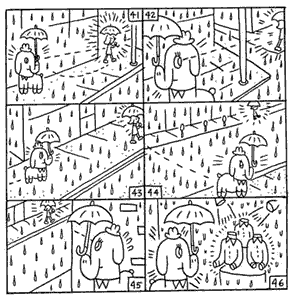
Death to tyrannical one-point linear perspective!
Isn’t one-, two- and three-point perspective more a function of what angle the image is drawn at than how the image is recorded? You use one-point perspective when you’re drawing something end-on, two-point when it’s at a ground-level angle, and three-point when it’s from an elevation.
Basically, any series of parallel lines which are not parallel to the viewing plane will, at a certain point, converge to a particular point of perspective. It has nothing to do with the fact there are two eyes or simple lenses or whatever. Also, the lens itself has nothing to do with perspective either (though I can see Hockney’s point that the emergence of optical lenses may have been a factor behind artists striving for more precision in their conveyance of depth).
The point is that you don’t have to use perspective at all, really, to draw things. One-point, two-point, three-point perspective are all drawing METHODS. What I’m interested in is the fact that many contemporary comics artists choose to completely ignore Western perspective methods, and go for the alternative ways of showing depth that McCloud outlines.
This says it much better than I did:
“Although every human being (of whatever ethnicity) experiences the natural visual illusion of parallel edges—like roadsides or railroad tracks—appearing to converge toward a point as they approach the horizon, it is not natural to reproduce this illusion in pictures. In other words, while everybody sees the same phenomenon in reality, no one, no matter how artistically talented, is innately predisposed to picture it (except, remarkably, certain autistic prodigies). Perspective is a technique that generally must be learned. Therefore there is no reason to believe that nature rather than nurture had anything to do with why artists in other ages and cultures did not pursue the “realism” preferred in the West.
Young children do instinctively make pictures from a number of viewpoints simultaneously….Until the infusion of Euclidean geometry and optics in the arts of western Europe during the early Renaissance, no artists anywhere had cultural need to have their pictures replicate the optics of single-viewpoint vision, and almost all the conventions they employed for signifying solid form and distant space—even in the most sophisticated art of the pre-Renaissance West and all other non-Western cultures—evolved from similar expressions found in the instinctive art of children.
This does not mean that non-perspectival pictures should be labeled “childlike” in the sense of being primitive (or inferior) to the Western style. Quite the contrary. Multiple viewpoints and other innate pictorial signifiers, such as placing nearby figures and objects at the bottom of the picture surface and those more distant at the top, have been refined into some of the most aesthetically beautiful and stylish painting in all art history. Manuscript illumination in medieval Persia is a fine example (Fig. 8). Interestingly, while medieval Islam possessed Greek optics, including Euclidean geometry, long before the West—with Muslim philosophers even adding their own commentary—Muslim painters never applied optics to art, and only used geometry for the creation of elaborate abstract designs in their magnificent architecture.
Artists in China and Japan, on the other hand, refined two perspective conventions that had naught to do with optical geometry. (Euclid was unknown in the Far East until the seventeenth century.) One method was a kind of axonometric projection whereby rectilinear objects were drawn as if their perpendicular sides were set at an angle, just as in Western perspective, but with their parallel edges remaining parallel and never converging (Fig. 9). The other convention, called aerial or atmospheric perspective, provided an effective illusion of distant landscape simply through the tonality of color. Far-off mountains, for instance, were painted in hazy gray or blue in contrast to the brighter colors of nearer foreground objects, thus creating an ideal complement to the Chinese predilection for philosophic contemplation. During the Renaissance, atmospheric perspective was also explored by Western artists, notably Leonardo da Vinci.”
And on and on and on. No idea about the source, but it’s a good summary.
http://science.jrank.org/pages/10637/Perspective-Other-Perspectives.html
this looks like a good bibliography, too:
Damisch, Hubert. The Origin of Perspective. Cambridge, Mass.: MIT Press, 1994.
Edgerton, Samuel Y. The Renaissance Rediscovery of Linear Perspective. New York: BasicBooks, 1975.
Kemp, Martin. The Science of Art: Optical Themes in Western Art from Brunelleschi to Seurat. New Haven: Yale University Press, 1990.
Summers, David. Real Spaces. New York, Phaidon, 2003.
White, John. The Birth and Rebirth of Pictorial Space. Cambridge, Mass.: Belknap, 1987.
Sure, and I totally agree with all that, I was just nitpicking about the (maybe implied?) notion that 1-point perspective was somehow an artifact of optical recording devices and that 2-point perspective was because you have two eyes.
I was going to have a little ramble about cubism where I was going to say something like, “Cubism at its core is about escaping from a specific concrete representation of perspective and using space to represent a changing vantage point, be it looking at an object from multiple angles or showing the progress of time. I totally dig cubism,” but I didn’t want to get bogged down on referring to a single alternative to fixed perspective and so on.
I should have been more clear and saved you a lot of work in finding stuff to quote and so on; I was really just responding to the notion that 1-point perspective was a way of trying to emulate binocular vision, as if binocular vision had anything to do with perspective.
no big deal! i see exactly what you were saying. i’m glad you brought it up, because afterwards I found that good stuff that further clarified what i was trying to say…i think the real issue i’m interested in here is east vs. west when it comes to perspective–something i know nothing about, but am looking into!
also: excellent point about cubism!
lens drawings need a bit of help…
conceptually gorgeous nonetheless
Just to clarify Fluffy’s point, I think the term you meant to use was “linear perspective.” One-point perspective is a type of linear perspective. It’s used when there is only one vanishing point needed to construct an object or a space in a picture.
Obviously when you say “death to one point perspective” it’s just fun hyperbole, but I think in rejecting linear perspective, you’re throwing out the baby with the bathwater. It’s an extremely useful system for describing basic physical facts in a picture, like the distance between objects or their relative size. And offering readers the illusion of varying degrees of depth in the panels of a comic does a lot to keep their eye interested.
Steve,
You’re right about both things: that I should’ve said “linear perspective,” and that the last statement was just fun hyperbole.
ihave mach wont the linear perspective
More research, this time on the Egyptians:
What is ancient Egyptian art?
this is only a little bit weird the pictures are very disturbing
Great post- cheers,
A.
Back to Hockneys theory of introducing optics to Renaissance painting and his terminology of Perspective. It is certainly confusing referring to 1 point perspective as though its by only looking from one eye or via a single lens. Thats rubbish, as you all seem to get it, what 1 point, 2 point and 3 point perspective really are. What i think Hockney has missed is the enterpretation of the picture plane to those old Renaissance paintings, not what perpective it is. Yes, okay they may have started to use mirrors and they were limited in size, so sub dividing of the composition occurred and in doing so there was a shift each time in the picture plane resulting in a change of the horizon line in the finished painting. Perspective change only occurs to the convergence or receeding the lines to the now new horizon on the picture. Changing the individual perspective would give results more like those aspective Egyptian ones. Thats not to say you cant have different sets of vanishing points for objects in pictures, i.e by objects placed at different angles to each other BUT there should only be ONE PICTURE PLANE. This is what the Renaissance guys altered, ending up giving their pics a slightly offset not fully realistic look. Thats my theory. Close Hockney but no cigar!!
i love this. may i please use the red and black ’15th C stereoscopic perspective’ piece as an illustration on my blogpost about the ways that personal perspective projects unfortunate identity upon the words and actions of another?
As I learn to draw cartoons I want all the methods of conveying 3-D at my workable disposal.In art school they taught the rudiments of perspective drawing including basic linear perspective.They really only teach the easy stuff, when confronted with a difficult problem you have to figure it out yourself,but isn’t that the way art is anyway? Linear perspective can be tricky when you start to apply it even if you have a good intuitive sense for it.You just have to conjure up scenes and practice drawing them alot. A good comic book artist should be able to utilize all methods of drawing 3-D and make them work together. The Grosz and Ron Rege are styles so a comic rendered in those ways would have to be rendered that way throughout the story or would look ridiculous mixed with linear perspective.Methods of perspective have nothing to do with style and any art work should be rendered in the same style throughout.Imagine x-men characters mixed with Manga characters.
I think most artists want a working knowledge of perspective without having to read and study a treatise on linear perspective. In Kimon Nicolaide’s “The Natural Way to Draw” there is an exercise where you are to draw some scene you have remembered in the last 24 hours,these scenes almost always involve people doing something, someone pumping gas a baseball game. If you do this drawing every day,as he recommends,the drawings get more accurate. After awhile you do the drawings from your imagination. It’s surprising how much of your intuitive sense of perspective comes out in these drawings.I guess you have to learn to draw what you see before you can draw what you don’t see,but is that really true? I think art schools should spend more time getting students to be able to draw what they don’t see too. It’s ridiculous for an artist not to be able to draw a car or a dog unless it’s right in front of them. I believe it is the same with perspective if you just dig deep you can visualize perspective in your head or just doodling on paper. With perspective I want to be able to use all of the methods just as I would want to use all the colors possible on my palette.