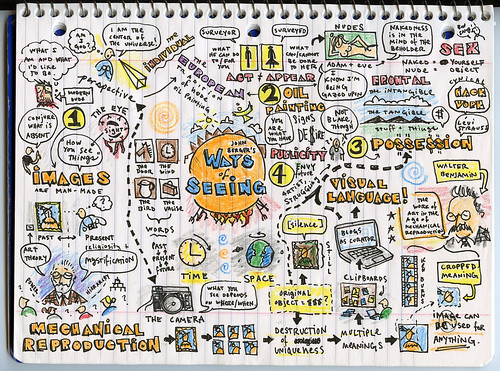
Fantastic book based on the 1972 BBC miniseries, which someone has uploaded to Youtube, and I’ve assembled into one handy playlist for your viewing pleasure. Amazing how much the contents remain valid in the age of the internet.
The first essay is about art in the age of photography and reproduction, and is based on Walter Benjamin‘s essay, “The Work of Art in The Age of Mechanical Reproduction.” Benjamin’s idea was that in an era where an image can be easily reproduced, art might be “freed up” and become available to a mass audience.
I’ve recently been going back and forth with an artist friend of mine about his fine-arts-based world (where his collectors value the original, one-of-a-kind) and mine (where there is no original, only reproductions, on the blog, in the book, etc). Our ideas about making art are very similar, but our business models couldn’t be more different!
I was with him and our wives at an opening in an art gallery in town last night and couldn’t get over how uncomfortable I felt about the whole thing. There was free beer, sure, but no artist’s statement, no postcards, nothing. There was only a photocopy of the price list, along with some goofy map of the exhibit that related “culture vs. nature” or something cliched along those lines…
Why so uncomfortable?
First, the idea that anyone has $10,000 to spend on a piece of art boggles my mind. Second, I find it alienating, as someone without the $10,000 to spend on art, to not be able to “own” or “buy into” or “take home” some part of the work. Regardless of how much you love the art, there’s nothing he can sell to you, there’s nothing you can buy into, no way for you to show your support or love for the work. All you can do is snap a bootleg shot on your camera phone. You feel like a f*&%ing second-class citizen: You can look, but don’t touch. It’s worse than a museum: at least in a museum you can buy a postcard or a book in the gift shop.
Contrast this with my experience at Maker Faire earlier in the day, where the idea was: come make things with us. Everyone is encouraged to join in.
Take our friends Bleep Labs. They had:
- Robots on sale for $125
- T-shirts on sale for $20
- Stickers for free
Art in the age of mechanical reproduction, indeed! Every level of merchandising was covered.
More thoughts on this to come.


i personally think that great or even good art needs no documentation. i was at the dallas museum years ago and most of the ‘modern’ art had pamphlets telling you some horse**** about the art.
i looked at some work by Peat. was that the show?
the earth should self destruct if someone would pay 10,000 for any of the work i saw on his site….
I think the other important point from the first essay was that reproduced art creates a phenomenon surrounding the “original” work of art. He mentions the nearly pilgrimage-like experience that people go through to see the original mona lisa. They aren’t going to have a unique experience with the art, they’re going for the experience of seeing the original.
I feel like this ties in with what you’re saying later, but I don’t have the presence of mind this morning to try to tie the loose threads together.
Neato. . . I’ve had the book for a while, but I need to browse through those clips since I’ve never seen the mini series.
Very cool! Wish I’d known you when I was teaching this book at Georgetown back in the 80’s. I would have used your accompanying “illustration” and maybe even some of your other artwork. I agree with most of your thoughts about art, by the way (or at least acknowledge their validity).
I thought Peter Schjeldahl put it well, in an aside in last week’s NYer:
“Art is unique among universally esteemed creative fields in its aloofness from a public audience…”
I like that word “aloofness”. Insider/outsider. Look, don’t touch. Dress codes. The Original. The Canon. etc.
Thanks for bringing up that article, Mark! I think the whole last paragraph deserves quoting (emp mine):
Just stumbled on your blog! What a treasure trove.
Isn’t there a middle ground where a post-recession art market is actually based on people’s passions about art. the passion a wealthy patron has about $10,000 art is the same as a kid pulling together 5 bucks for a comic.
Patronage could make work more available to everyone. More democratic.
Austin, your work could be high-end wall art as well as popular book art and free web art.
Like I said, I really like the way Bleep Labs had merchandise available in 3 tiers.
Bands like NIN and Radiohead are selling music this way: free mp3s on the internet, deluxe cds/LPs, and super-deluxe box sets for collectors.
My three tiers (eventually):
1) free blog posts
2) $10-20 books
3) higher-priced prints and original artwork for collectors
Thanks for being so generous with your ideas and your art! I’m using Berger’s book in the context of a lower division lit and critical thinking class and will be posting this image on my “teaching” blog right away, and encourage my students to come visit you also!
@gwen hope your students dig it!
how can one interpret contemporary artists in the light of Berger