BLOG ARCHIVES

Posts Tagged ‘a terrible calamity at sea’

HEY! THE XMAS CURTAIN CALLS

Thursday, December 7th, 2006

“My working method has more often than not involved the subtraction of weight.”

—Italo Calvino, Six Memos For The New Millenium

03.gif

04.gif

Drew these two pages while listening to a solo KCRW gig by My Morning Jacket’s Jim James. Jim James’ voice + silo reverb = heaven. A beautiful equation.
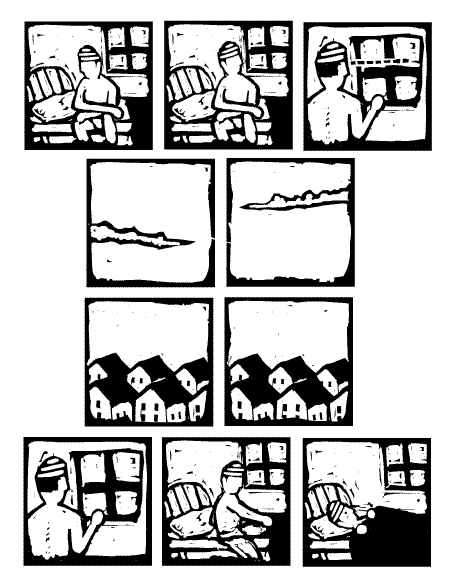
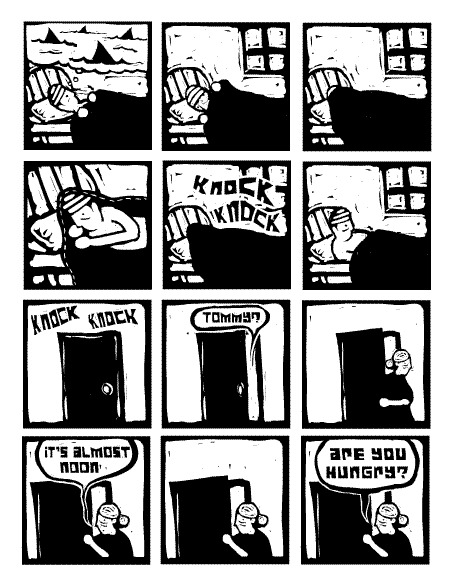
WHAT IF WE GIVE IT AWAY?

Monday, December 4th, 2006

Forbes had a “Special Report” on Books over the weekend, with some really great articles, especially one on the success of McSweeneys, and Cory Doctorow’s “give freely and they will buy” business strategy.

Doctorow really has his head straight. It seems ludicrous, but showing generosity towards your readers, giving them clips and “free stuff,” really does, in the long run, get you further than staying secretive about your work. That’s why, today, I’m posting not one, but TWO pages of work.

Comments, as always, are appreciated.

01.gif

02.gif

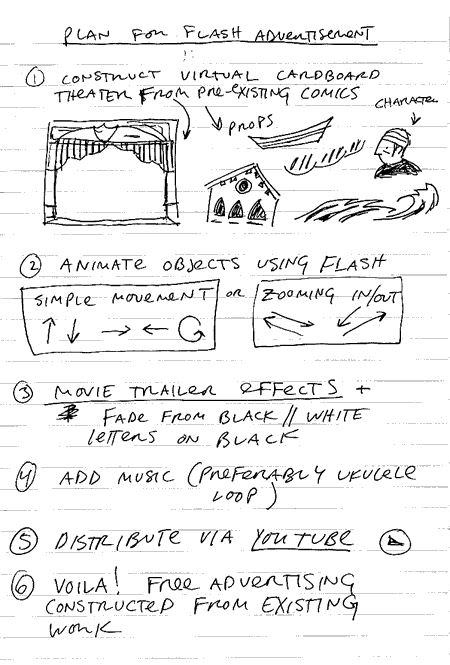
USING FLASH AND YOUTUBE TO MAKE A TRAILER FROM PRE-EXISTING MATERIAL

Wednesday, November 15th, 2006

Plan inspired by a post on Dan Zettwoch’s blog and Stanley Donwood’s work for The Eraser:

flashadvert.gif

Now I just gotta learn to animate using Flash…

THE IMPORTANCE OF DOODLING

Friday, November 10th, 2006

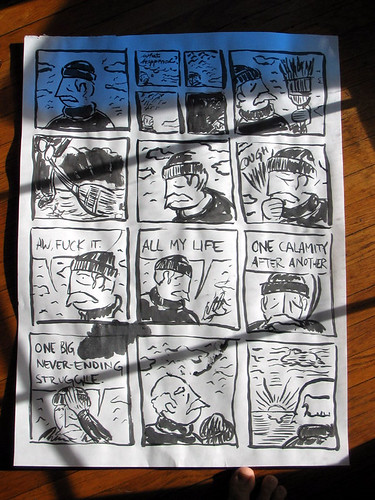
To loosen up in the morning, I pull off a huge sheet of trashy sketch paper and doodle with my sumi-e brush. Sometimes I copy cartoons out of other books, just to get the flow going. Sometimes I work on the easel, sometimes I work on the coffee table, sometimes I work on the floor in the sunshine…
I can’t express how elated we are to be finished with the GRE. Pythagorean triangles are no longer invading my dreams. Take that, ETS.

But oh, will it be a race to the finish line for the rest of the year. The wedding, the applications, the book…one thing ends, and twenty other things take it’s place.

We’ve got company coming this weekend, so we’re gonna spend it celebrating! You should too!

PAUL WAS AN APOSTLE, JUDAS WAS AN APOSTATE

Monday, October 30th, 2006

frank2.gif

Greetings from GRE-studying hell! For the next two weeks, your humble entertainer will be busy learning obscure words. Words like “adumbrate,” “bedizen,” and “calumniate.” (He admits, he has only made it past the letter “C” in his Hit Parade.)

To keep his sanity, your humble entertainer will still be scratching and posting pretty pictures, and might even continue giving those pictures silly mnemonics titles, like: “chary is to be wary!,” “asperity is severity!,” and “a minister prone to cozen, a congregation hozen!”

And if text and links are what you’re looking for, go see Jessa at Bookslut. She’s been killin’ it lately.

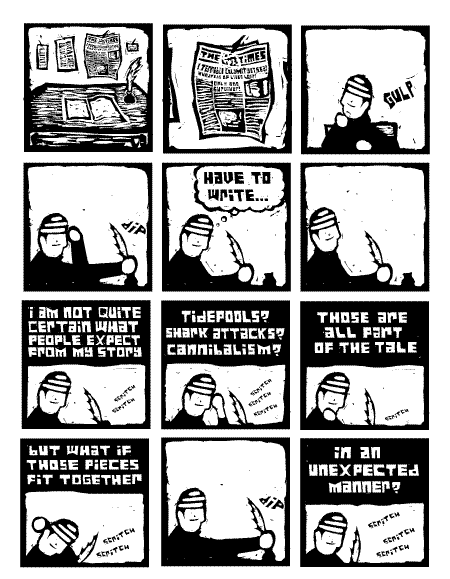
EXCERPTS FROM A TERRIBLE CALAMITY AT SEA!

Monday, October 30th, 2006

An (abandoned) graphic novel-in-progress:

terrible calamity cover

a terrible calamity at sea!

a terrible calamity at sea!

a terrible calamity at sea!

a terrible calamity at sea!

a terrible calamity at sea!

a terrible calamity at sea!

a terrible calamity at sea!

terrible calamity at sea

COPYING

Friday, October 27th, 2006

“I think copying someone’s work is the fastest way to learn certain things about drawing and line. It’s funny how there is such a taboo against it. I learned everything from just copying other people’s work.”

- Lynda Barry

kingcopy.gif

This is my copy of some of the panels from a 1930s Gasoline Alley strip that Frank King drew in the style of a woodcut. I superimposed my own characters. Supposedly, Chris Ware loved this particular strip so much that he tore the page out of the Smithsonian Collection Of Newspaper Comics book and had it mounted on the wall of his studio.

Mine’s a library copy, so I can’t go that far.

IT SOUNDS GREAT WITH THE VOLUME DOWN

Friday, October 20th, 2006

lovestory.gif

My friend Brandon (who keeps refusing to answer my e-mails now that he’s a fancypants graduate student — maybe he’ll read this and feel guilty) once told me that in the lazy afternoons, he’d been watching soap operas with sound off, writing his own dialogue for the characters on the screen. I thought that sounded like a fun writing exercise, but wasn’t sure what the equivalent would be for drawing.*

Then, a few weeks ago I came across a crappy-looking movie that was shot in the same whaling town one of my characters lived in. So I picked up the DVD, sat down with my sketchbook in front of the TV. But instead of watching it, I used the fast forward and pause buttons to freeze-frame scenes that I thought were pretty decent. Then I super-imposed my own characters over those scenes.

By the time I’d made it through the movie, I had several pages worth of comics panels (without dialogue — but you could certainly add dialogue), and it occured to me, you could do a whole comic like this, if you really wanted to.

* Though, come to think of it, Kenneth Koch used to give his poetry students comic books that they’d never read, and order them to white-out the speech balloons without reading the dialogue, and write their own….

MISTAKES WERE MADE

Tuesday, October 3rd, 2006

“Conventionally, historical fiction is a personal story with world-historical rear-screen projection…. The protagonist is usually a reflector, not an actor, an ordinary man or woman whose life is blown off course by the storm of great events. This is the conventional method because it is the prudent method: the writer does not have to imagine what it was like to be Robert E. Lee or Abraham Lincoln, only what it might have been like to be a righteous but disillusioned Confederate deserter in love with a plucky girl.”

- Louis Menand, on Charles Frazier’s Cold Mountain

exhaustion.gif

Darby was nice enough to give me a shoutout the other day, and mentioned that I was working on a graphic novel, and I thought, “oh crap…I am working on a graphic novel!” and proceeded to be very guilty about my output, much like I was when Gwenda said nice things about me a month or so ago. So today, I’m posting a several-months-old page from Calamity, for two reasons: one, to give everybody another taste of what i’m working on, and two, to try to get my ass into gear and continue the work.

* * *

Here’s a nice little NPR clip on The Virginia Quarterly Review that points out that part of its appeal is the strong attention to graphic elements and design (including comics) that Ted Genoways has brought to the journal.

* * *

This afternoon while I was eating lunch, I listened to a local radio show on the Ohio senate race, which, coincidentally, included Dan on its panel of speakers (because of his two recent NyTimes Op-Eds). I note this here because Dan mentioned one of my favorite essays ever, Charles Baxter’s “Dysfunctional Narratives, Or ‘Mistakes Were Made‘.” In the essay, Baxter talks about passive voice, and how it’s been used in American politics to deny accountability:

[The Reagan and Bush] administrations put the passive voice, politically, on the rhetorical map. In their efforts to acquire deniability on the arms-for-hostages deal with Iran, their administrations managed to achieve considerable notoriety for self-righteousness, public befuddlement about facts, forgetfulness under oath, and constant disavowals of political error and criminality, culminating in the quasi-confessional, passive voice–mode sentence, “Mistakes were made.”

He goes on:

[Speech like this creates] a climate in which social narratives are designed to be deliberately incoherent and misleading. Such narratives humiliate the act of storytelling. You can argue that only a coherent narrative can manage to explain public events, and you can reconstruct a story if someone says, “I made a mistake,” or “We did that,” but you can’t reconstruct a story—you can’t even know what the story is—if everyone is saying, “Mistakes were made.” Who made them? Well, everybody made them and no one did, and it’s history anyway, so we should forget about it. Every story is a history, however, and when there is no comprehensible story, there is, in some sense, no history; the past, under those circumstances, becomes an unreadable mess. When we hear words like “deniability,” we are in the presence of narrative dysfunction, a phrase employed by the poet C. K. Williams to describe the process by which we lose track of the story of ourselves, the story that tells us who we are supposed to be and how we are supposed to act.

The whole essay is brilliant. Read it.

IT’S EDUCATIONAL!

Friday, September 8th, 2006

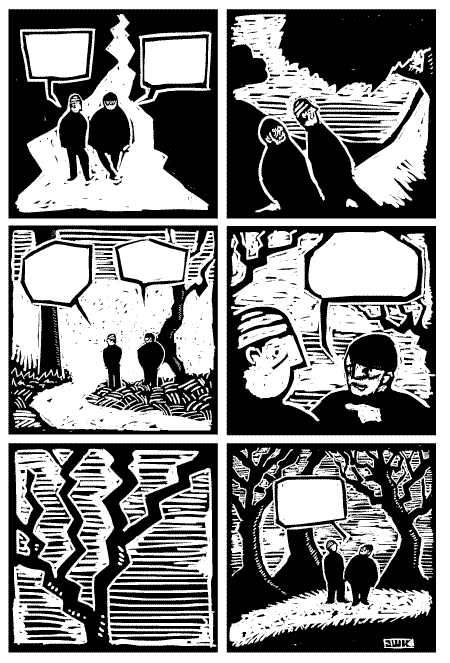
14.gif
This is a couple-of-months-old page from the first draft of Calamity, when I really didn’t know where I was going (as opposed to now — HA!), and there were twin brothers in the story. I like the background a lot, but the layout is pretty boring: a lot of cut-and-paste and stage-like monologuing. The good news, as we all know, is that you learn just as much by failing as you do by succeeding, and considering that I’ve already thrown out a couple dozen finished pages of artwork, I’m learning a hell of a lot…

There’s something about this time of year, when that fall breeze starts creeping into the air, I immediately think: time to go back to school! But last September, after 17 years, that butterfly in my belly was pinched by the disappointing fact: you’re no longer a student.

Or at least a student who pays tuition.

So, today I’m going to post a couple of quotes by different comic artists about teaching yourself how to do this thing.

* * *

“A comics-art curriculum is interdisciplinary. As comics-art students learn to become literate and visually literate, they need to develop a vast array of skills. They need classes in drawing, writing, computer art, literature, storyboard, and character design. They need research skills, so they can make their stories convincing and make their characters behave and look real enough to come alive on the page or screen.”

- James Sturm, “Comics In The Classroom

* * *

“…[he] discovered Dickens and Lewis Carroll and Thackeray, superb story-tellers whose tales were often co-created with the most gifted comic artists of their time. Dickens would toil over the drawing board with cartooon illustrators like Cruikshank and Browne (Phiz) to get the graphic portrayal of a character like Sairey Gamp or Mr Pecksniff exactly right, considering his novel illustrations an integral part of his books. (In our desolate time, publishers have no knowledge of this and routinely repting Dickens sans the crucial cartoon art.) George reveled over these novel combinations of art and text and longed to tell stories involving his own comic characters developed in depth over time…”

- Bill Blackbeard on George Herriman, creator of Krazy Kat, in his introduction to Krazy & Ignatz 1931-1932: A Kat a’Lilt with Song

* * *

“This book was created on a lark. Actually, it was never even intended to be a book at all — merely an exercise in one of my sketchbooks. Around the time I began doodling it out, I had been particularly interested in a certain kind of storytelling I had noticed several other cartoonists working with — specifically Dan Clowes, Chris Ware, and David Heatley. It’s an approach wherein you tell a longer story through a series of shorter, unconnected comic strips. Cumulatively they add up to a bigger picture….I went in knowing very little about where the story was going. I made it up page by page as I drew it out….The whole thing was just meant to be fun.”

- Seth, “The Origin of Wimbledon Green”