BLOG ARCHIVES

Posts Tagged ‘BOOKSHELF’

R. CRUMB ON COLLECTING AND DAVID KUNZLE’S THE EARLY COMIC STRIP

Friday, March 2nd, 2007

kunzle.jpg in_the_studio_1.jpg

R. Crumb talks about David Kunzle’s The Early Comic Strip in Todd Hignite’s excellent In The Studio: Visits With Contemporary Cartoonists:

My awareness of this whole history was something that happened gradually, since that stuff is not available. Where are you going to see it? You’d have to go to some library that specializes in that and ask to look at it. It’s not reprinted anywhere, so it’s not known. So when I got that big book by Kunzle, it was a total surprise, how much material there was, and I’m sure that’s still just a drop in the bucket, you know, what survived, what he could get his hands on, and what he could actually show — I’m sure he could have done twice as much. So much of them are so crude, those little, postage stamp-sized panels of, like, husband-and-wife squabbles done in Russia or Germany or Czechoslovakia. Incredible stuff, but totally obscure. If you try to inform people in the art world of this history, they know nothing about it. A complete underground, unknown, history of popular art that the general art world knows nothing about. When Alfred Fischer, the curator of my show in Germany [at the Museum Ludwig in Cologne] came, I showed him this book and some other things and he was just speechless; it was all completely new to him. The crude, lowest level of popular arts.

What I love about Hignite’s book is that it focuses most of its attention on the cartoonists’ influences, personal libraries, and thoughts about the history of the form. As Hignite comments, “To varying degrees, these artists are collectors themselves, so the process of creating is interwined with other art: the working studio is also library archive, and museum.” Later in his interview, Crumb goes on to lament the difference between this kind of collecting versus “academic” interests:

It’s just that academia’s interest in this stuff is so lame….There’s a big difference between a collector-archivist and people in academia….In academia they get locked into this thing of having to narrow it down and narrow it down to this very particular specialty that they focus on, and they’re very proprietary about it, so that it scares them to actually scan the culture at large as we do and just pick out, “Oh, this is interesting,” o, “That’s interesting from this whole different area,” and then look into it; that’s a waste of their time. There are probably exceptions, but it gets narrower and narrower as there get to be more academic specialists and specialties. You have to be so specific about “you” things, and if someone else who’s not the expert volunteers some information, then it’s almost a threat.

More and more, my vision of comics as a type of collage – a spattering of pictures, words, influences, events, personal histories, books, whatever…go read the Lethem article, where he says, “In fact, collage…might be called the art form of the twentieth century, never mind the twenty-first.” — synched together in a unity of style, grows and strengthens in my head. Which is why reading — ammassing influence — is such an important part of the gig…

KUNZLE’S HISTORY OF THE COMIC STRIP, VOLS. 1 & 2

Friday, February 9th, 2007

kunzle.jpg

“Kunzle’s book…has gone virtually unnoticed by the comics community but is an enormously important work, covering nearly 400 years of forgotten European comics. Check it out!”

—Scott McCloud, Understanding Comics

Unfortunately, the two volumes of David Kunzle’s mammoth study are long out of print, and the used copies are selling on Amazon for hundreds of dollars. I e-mailed Professor Kunzle (he’s part of the Art History Department at UCLA) to see if there was any chance of seeing it back in print. He said no, but that he has two books on Rodolphe Topffer, a facsimile of his eight comic strips, and a monograph, coming out from University Press of Mississippi in April.

If you’re a comics geek and you’re ready to go back further than Little Nemo and The Yellow Kid, it’s really worth it to track down copies of these books. I got mine through interlibrary loan. Here are links to find the books in a library near you:

The History of the Comic Strip, Vol. I: Picture Stories and Narrative Strips in the European Broadsheet from c.1450 to 1825

The History of the Comic Strip, Vol. II: The Nineteenth Century

ESPRESSO + LIBRARYTHING

Thursday, January 18th, 2007

Trying my best to copy Don, I bought an espresso machine and started playing around with LibraryThing. It’s my day off, so I’m going to spend it on caffeine, reading like a madman, and blogging like crazy to make up for the severe lack of posts lately. Stay tuned.

As for the reading: In addition to being a National Book Award nominee, Gene Yang did his master’s thesis on comics and education. Dover Thrift has some really cheap, really amazing art books. Joann Sfar is one of the best men in comics, period. McCarthy’s new book is dark, depressing, and beautiful — like his last one, I think it’s basically a pulp novel, begging to be made into a movie. Saul Steinberg is January’s greatest (re)discovery.  Arnheim’s book is on Tufte’s reading list, so I’m down.

MY READING YEAR, 2006

Tuesday, December 12th, 2006
Soccer in Sun and Shadow, New Edition

10. Soccer In Sun and Shadow by Eduardo Galeano

The ultimate bathroom reading. Short, smart, prose-poem chapters about soccer. Picked it up because Barry Yourgrau (another good bathroom read) recommended it. Became an instant fan.

Making Comics: Storytelling Secrets of Comics, Manga and Graphic Novels

9. Making Comics by Scott McCloud

Not as good as Understanding Comics, but way better than Reinventing Comics. Any McCloud release is an event. Thrilled to see a chapter on world-building in there. Will make a good textbook someday.

six memos for the new millenium

8. Six Memos For The Next Millennium by Italo Calvino

Intended as lectures, Calvino died before he could give them. The first five, Lightness, Quickness, Exactitude, Visibility, and Multiplicity, were written. The sixth, Consistency, was not. A hell of a collection of last words from a hell of a writer.

bks-beautifulevidence.jpg

7. Beautiful Evidence by Edward Tufte

The fourth of Tufte’s books, contains his devastating pamphlet on Powerpoint, which should be required reading for everyone. Come to think of it, all of his books should be required reading — in the age of pictures and words, they could take the place of freshmam composition…

rabbis cat

6. The Rabbi’s Cat by Joann Sfar

The Rabbi’s cat swallows a parrot and announces his ambition to learn the Torah. Loose, wonderful drawings, a no-nonsense structure, and a great story. Didn’t get to read Sfar’s Vampire Loves, but that looks excellent too.

Mother Night

5. Mother Night by Kurt Vonnegut

Gallows humor, anyone? Picked this up because I read that it was Etgar Keret’s favorite Vonnegut. Devoured it in one sitting during a sunny afternoon on our balcony.

Curses

4. Curses by Kevin Huizenga

I haven’t actually put my hands on the Curses collection (it’s on the xmas list), but when I was at Quimby’s in Chicago, I bought every Huizenga comic they had, and after that, ordered everything available through USS Catastrophe (including his great booklet for the Center for Cartoon Studies). Along with the stuff available online, I’ve read a good bit of what’s gonna be in the book. His blog is great, too.

166xgeneric.jpg

3. Consider The Lobster by David Foster Wallace

“I don’t know a whole lot about non-fiction journalism, but the way i think about [it] in terms of what I can do is: I think of it as a service industry. Essays like this are occasions to watch somebody reasonably bright but also reasonably average pay far closer attention and think at far more length about all sorts of different stuff than most of us have a chance to in our daily lifes…”

Brilliant dude, brilliant essays. Still haven’t read a bit of his fiction.

Fun Home: A Family Tragicomic

2. Fun Home by Alison Bechdel

A story that couldn’t be told in any other form than a comic book. I loved meeting Alison, and her Powerpoint presentation about the “making of” made the book seem even more brilliant. Best book published this year, hands down.

CRUDDY: An Illustrated Novel

1. Cruddy by Lynda Barry

Next to getting married, meeting Lynda Barry and hearing her read from Cruddy was probably the event of my year. To me, Lynda is the perfect model of a writer and an artist. This book is just too cool for words.

DOUBLE-SPACED, 12 POINT, TIMES NEW ROMAN STRAIGHTJACKET

Monday, November 20th, 2006

Short week, this week, what with the holiday coming up and all.

Had a marvelous weekend full of running around and reading books. My reading habits are fluctuating wildly these days between non-fiction, books on design, and comic books. Not too much interest in prose fiction at the moment, although I’ve been dipping into Oliver Twist (which is pretty hilarious, actually, and kind of like a verbal cartoon) here and there.

I spent a lot of this weekend watching football (!): Michigan vs. Ohio State, Notre Dame vs. Army, and the Browns vs. Steelers. This guy named Frank Caliendo does a hilarious John Madden impression. There’s something about John Madden’s voice that makes me depressed — all those wasted Sunday afternoons in front of the TV with my uncles.

[gv data="OSc3e4RoYhA"][/gv]

Oh, and Taxi Driver was on AMC Saturday while we were at Meg’s parents. DeNiro is such an absolute joy to watch:

[gv data="oHzMfab9ULg"][/gv]

* * *

This is a quote from a book called Reading Images: The Grammar of Visual Design:

Until now, language, especially written language, was the most highly valued, the most frequently analysed, the most prescriptively taught and the most meticulously policed code in our society. [If] this is now changing in favour of visual communication, educationalists should perhaps begin to rethink what ‘literacy’ ought to include, and what should be taught under the heading of ‘writing’ in schools. If schools are to equip students adequately for the new semiotic order, if they are not to produce people unable to use the ‘new writing’ actively and effectively, then the old boundaries between ‘writing’ on the one hand, traditionally the form of literacy without which people cannot adequately function as citizens, and, on the other hand, the ‘visual arts’, a marginal subject for the specially gifted, and ‘technical drawing’, a technical subject with limited and specialized application , should be redrawn.

Yep, double-spaced, 12 point, Times New Roman font is a straightjacket that I won’t wear any more. I won’t do it. No sir.

SKULKING AROUND BARNES AND NOBLE

Thursday, October 26th, 2006

cover.jpg

I really need to get an office.

Right now, our living room doubles as my workspace, and that’s bad, because when I step into the room in the morning, I don’t know whether to write, or take a nap on the couch.

It’s better today, because the radio’s on, and there’s actually SUNLIGHT coming in the front window.

Yesterday I got so stir-crazy I went to Barnes and Noble with my sketchbook to work. I ended up doing little work, and a lot of reading.

I spent the majority of the time reading Ivan Brunetti’s fantastic new anthology, GRAPHIC FICTION, CARTOONS, & TRUE STORIES. (Here is the table of contents.) If you’re a newcomer to comics, this is probably the new place to start. It’s pretty amazing. I especially like the 20-page section dedicated to Peanuts, which included Art Spiegelman’s New Yorker tribute piece, “Abstract Thought Is A Warm Puppy” and an essay by Schulz himself, “Developing A Comic Strip,” which Brunetti uses in all his classes. (WMFU had an interview with him about the book a few days ago, and here’s another with Mr. Skin.)

Yale University Press has a really outstanding line of comics-related books on the market right now. In The Studio: Visits With Contemporary Cartoonists is probably the most unique: it features monologues and skethbook work by folks like Crumb, Panter, and Brunetti, but it also includes personal artifacts from each cartoonists’ stash: old magazines and comics, toys, posters, etc. The best part is Crumb talking about his current project: he’s illustrating every story from Genesis, using three different translations, and “telling it straight.” I can’t wait to see this. It’s going to be 180 pages long, and supposedly, he’s 60 or so pages into it.

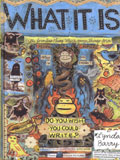
But the winner yesterday was the new “graphic” issue of TIN HOUSE. It has a ten page or so excerpt from Lynda Barry’s WHAT IT IS, a new collage/book/thingie about images in progress, and an interview with her, too, not to mention stuff from Stuart Dybek, Marjane Satrapi, and a childhood comic by Dan Chaon.

I love the fact that Lynda sells her stuff over Ebay. Even her “throwaway” sketchbook pages blow my mind:

08_3.jpg

f8_3.jpg

Here’s a student summary of one of her workshops about “the image” and writing.

STAR WARS AND COUGH DROPS

Monday, October 9th, 2006

It seems like just about everybody has the plague these days, and over at our place it’s no different. I spent the weekend recovering from the crud, watching the Star Wars trilogy on DVD, reading comic books and Elmore Leonard, and eating like a hog. (Starve a fever, feed a cold.)

The best thing about the trilogy box set is a 2 1/2 hour long documentary called Empire of Dreams. It mostly focuses on the first movie, but it does a pretty amazing job at putting Star Wars — which seems like it came out of nowhere — into a context.

What interested me the most was the huge role played by Ralph McQuarrie, a conceptual design artist who Lucas hired to make paintings of several scenes (including C-3P0, R2-D2, a lightsaber battle, stormtroopers, and Darth Vader) so that Lucas could take them to the studio and say, “This is what it’s going to look like.” Essentially, McQuarrie’s drawings sold the movie, and got the thing made, but not only that, he created the look of the films. He took what was in Lucas’s head, and made it come to life.

Pictures trumped words.

You can see a bunch of these things at McQuarrie’s website.

Other inspiration from the weekend? Check out Tom Gauld’s Guardians of the Kingdom:

Tom Gauld’s "Guardians of the Kingdom"

I love pretty much everything that I’ve seen from him.

And I can’t say it enough: if you haven’t read Elmore Leonard before, you are in for a real treat. Killshot is about to come out as a movie.
Ok, that’s all I can think of. Between wedding plans, GRE, and grad school apps, there’s not much time for anything else, but maybe I’ll put something pretty up this week.

THE HEROES IN THIS BATTLE ARE DUMPSTER DIVERS AND PACKRATS

Tuesday, September 5th, 2006

Making Comics: Storytelling Secrets of Comics, Manga and Graphic Novels Double Fold: Libraries and the Assault on Paper (Vintage) Persepolis: The Story of a Childhood
Louis Riel: A Comic-Strip Biography The Freddie Stories Esquire\'s Things a Man Should Know About Marriage: A Groom\'s Guide to the Wedding and Beyond

I’ve been thinking lately about paper.

After the Great Powerbook Crash of ‘06, I’m growing ever more skeptical of digital media. Even though I do a great deal of my drawing on the computer, I’m rediscovering the joy and permanence of filling notebooks.

And ever since we had to cancel our subscription to the New York Times, it’s been a real treat to head over to the future parents-in-law’s to dirty up my fingers with newsprint.

* * *

What else got me thinking about paper?

Cartoonist Kevin Huizenga (who has a new book coming out soon) had a great post a few days ago about Bill Blackbeard, the history of archiving Krazy Kat strips, and Nicholson Baker’s Double Fold. Here’s the jacket copy from Double Fold:

Since the 1950s, our country’s libraries have followed a policy of “destroying to preserve”: They have methodically dismantled their collections of original bound newspapers, cut up hundreds of thousands of so-called brittle books, and replaced them with microfilmed copies — copies that are difficult to read, lack all the color and quality of the original paper and illustrations, and deteriorate with age. Half a century on, the results of this policy are jarringly apparent: There are no longer any complete editions remaining of most of America’s great newspapers. The loss to historians and future generations is inestimable.

In my brief tenure working in a public library, I’ve witnessed this depressing phenomenon first-hand. Due to budget restrictions, libraries are increasingly being run as retail chains (like everything else in this country, the pull towards privatization is strong), and so, in a bid for more space, the mantra is if you can get it online, drop the paper copies (so we can make room to put in more computers for tax payers to check e-mail and look at porn.)

The problem is, the majority of online references include no layout or graphics. So yes, you can read that Plain Dealer article from 5 years ago, but you won’t see any photography or the graphics that went with it. (Some databases, like the New York Times Historical Database or say, The Complete New Yorker, remedy this problem beautifully by using PDF technology.)

The only reason Krazy Kat survived this coup was through the efforts of a dedicated fan who clipped each and every color strip and donated his run to a historical society in Wisconsin.

Otherwise, the strips would be rotting in a dumpster somewhere.

* * *

Cool fact: 2 hours away, the Cartoon Research Library at Ohio State has six tractor-trailers worth of old newspapers that Bill Blackbeard sold to the university.

* * *

I’m researching a good deal of The Book through microfilm, and therefore, spending a lot of time squinting.

The nice thing about paper? It’s ridiculously high-resolution. No squinting required. And you can stick it in a big file folder to sift through later.

Edward Tufte, in his brilliant tirades against PowerPoint, has repeatedly championed this triumph over digital media:

Overhead projectors and PowerPoint tend to leave no traces; instead give people paper, which they can read, take away, show others, make copies, and come back to you in a month and say “Didn’t you say this last month? It’s right here in your handout.” The resolution of paper (being read by people in the audience) must be ten times the resolution of talk talk talk or reading aloud from bullet lists projected up on the wall. A paper record tells your audience that you are serious, responsible, exact, credible. For deep analysis of evidence and reasoning about complex matters, permanent high-resolution displays are an excellent start.

So yeah. Let’s hear it for paper!

HAVING OUR CAKE, AND EATING IT TOO

Monday, August 7th, 2006

In the Lake of the Woods Cash: The Autobiography Shuck Unmasked The Ticking

Get Shorty The Story of a Shipwrecked Sailor Y: The Last Man Vol. 5: Ring of Truth Fun Home: A Family Tragicomic

Spent the weekend travelling to Cincinnati and Oxford, planning for our wedding. If you’ve never been cake tasting, I highly recommend it. Just pretend you’re having a wedding, set up an appointment at a bakery, show up, and cake is brought out to you to taste! For free! Bring as many people as you can fit in the car! Make it a party!

We brought my mom with us. Mom and I used to have great trips down to Oxford when she was driving me to school. We started this weird tradition of always listening to Bob Dylan (and playing “Oxford Town” on the way up the hill to Miami). For this trip, we had 14 episodes of Bob’s radio show to listen to. He’s done a theme show on weddings, which was appropriate.

“While we’re on the subject of marriage, here’s what Minnie Pearl had to say about it: ‘Gettin’ married’s a lot like gettin’ into a tub of hot water. After you get used to it, it ain’t so hot.’ Rodney Dangerfield had this to say: ‘My wife and I were happy for 20 years. Then we met.’ “

He also quoted Groucho Marx: “Marriage is a wonderful institution…but who wants to live in an institution?”

* * *

Other things: I got some time on my old piano, trying out some arrangements of our wedding music. Which reminds me, I’m really looking forward to seeing the Ditty Bops live. They’re keeping up this cool blog about their bicycle tour, complete with a comic strip!

Since working on a graphic novel, I’ve been listening to a ridiculous amount of music. Right now, I’m listening to Everclear’s old one, SPARKLE AND FADE. What happened to these guys? Somebody should re-record “Santa Monica” as a country song. It’s a great tune for the apocalypse: “We can live beside the ocean / leave the fire behind / swim out past the breakers / watch the world die.”

Have I ever told you about my theory that all great bands should make a country album? Everclear would be one of them. The Shins would be another.

I don’t know about Love. Poor old Arthur Lee died this weekend. Meghan used to listen to Calexico’s version of “Alone Again Or” over and over on the way home from work. If you go to YouTube, you can see them on TV doing my favorite song, “A Message To Pretty.”

* * *

Something I forgot to post up at the top as a great read: Re: A Guide To Reproduction, a free PDF file by Jordan Crane and some other folks that tells you everything you need to know about xeroxing, silkscreening, scanning line art, and scamming Kinko’s. It’s really something else. Go to your library and print the sucker out for free.

* * *

On top of all this, I forgot to mention that we had to hit up a family reunion on Sunday. I had a few family members come up to me and say, “Oh, I saw your website!” And I said, “Cool!” And they said,” Yeah! I didn’t understand a word of it, but it looked pretty neat!”

So if you’re family, hello.

Tomorrow I’m going to post about a little treasure I found at my Mom’s house…

MO’ BOOKS, MO’ PROBLEMS

Thursday, June 15th, 2006

Modern Arf The Botany of Desire: A Plant\'s-Eye View of the World That Yellow Bastard (Sin City, Book 4: Second Edition) The Hero with a Thousand Faces (Mythos Books)

Arguing Comics: Literary Masters On A Popular Medium (Studies in Popular Culture) Understanding Comics Y: The Last Man Vol. 1: Unmanned La Perdida