Read more about Newspaper Blackout Pre-order the book on Amazon.com

BLOG ARCHIVES

Posts Tagged ‘comics as poetry’

LELAND MYRICK ON TURNING POETRY INTO COMICS

Tuesday, October 23rd, 2007

Leland Myrick’s MISSOURI BOY started out as a batch of poems that he put together and made into a graphic novel. He has a wonderful post about the process over at the First-Second blog:

…the poems that eventually became MISSOURI BOY were written over a span of almost ten years and were quite different in form, ranging from blank verse to haiku. When the idea finally gelled that I would take all these disparate poems and meld them into one coherent graphic novel, I began to think about the process of turning poetry into comics, and in thinking about the process, I began to feel my way toward the kind of book I wanted MISSOURI BOY to be when it was finished. What I did NOT want was a book of illustrated poems. What I wanted was a graphic novel that moved through time and in the end told one large story through a bunch of little moments strung together, the little moments fairly clear in themselves, but the larger story more indistinct as seen through the scattered lenses of the individual chapters.

One of the most important things that happened in the transformation from poem to comic was the loss of words. My editor, Mark Siegel used what became an important phrase for me in the early stages of the book when I was still struggling with keeping the language of the original poems intact—Let the words fall away. And so I did. In my head I saw the words falling away, floating leaves settling on the floor around my drawing table.

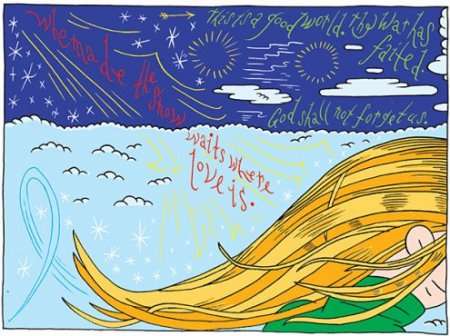
SETH ON PEANUTS: COMICS = POETRY + GRAPHIC DESIGN

Monday, September 10th, 2007

SETH ON PEANUTS AS A HAIKU

The cartoonist Seth, from an interview with Carousel Magazine [PDF] :

“I have felt, for some time, a connection between comics and poetry. It’s an obvious connection to anyone who has ever sat down and tried to write a comic strip. I think the idea first occurred to me way back in the late 80’s when I was studying Charles Schulz’s Peanuts strips. It seemed so clear that his four-panel setup was just like reading a haiku; it had a specific rhythm to how he set up the panels and the dialogue. Three beats: doot doot doot— followed by an infinitesimal pause, and then the final beat: doot. Anyone can recognize this when reading a Peanuts strip. These strips have that sameness of rhythm that haikus have— the haikus mostly ending with a nature reference separated off in the final line.

As time passed I began to see this connection as more and more evident in how I went about writing my own work. Certainly, it is not a process that is very tightly worked out — but when I am writing a comics page (or sequence of pages) I am very aware of the sound and ‘feel’ of how the dialogue or narration is broken down for the panels. If you have to tell a certain amount of story in a page then you have to make decisions on how many panels you need to tell it. You need to arrange these panels — small, big or a combination of the two — and decide how to sit them on the page. All these decisions affect how the viewer reads the strip; there is an inherent rhythm created by how you set up the panels. Thin panel, thin panel, long panel: this rhythm is felt by the reader, especially when you put the words into the panels. When writing a comic strip I am very aware of how I am structuring the sentences: how many words; one sentence in this panel; two in this one; a silent panel; a single word. These choices are ultra-important in the creation of comics storytelling, and this unheard rhythm is the main concern for me
when I am working out a strip.

I imagine poets feel this same concern. If you read any free verse poetry you can see how the poet has made certain decisions for how to break the thoughts apart and structure them, often in a way that defies a system.

It seems to me that the language of poetry is very dependant on setting up images and juxtaposing them against each other. A poet will create an image in the first two lines of his poem and then he will create another in the next two lines, and so on. I do find this jumping from image to image in poetry to be a very interesting, comic-like element. Many poems are almost like word comics.

Comics are often referred to in reference to film and prose — neither seems that appropriate to me. The poetry connection is more appropriate because of both the condensing of words and the emphasis on rhythm. Film and prose use these methods as well, but not in such a condensed and controlled manner. Comic book artists have for a long time connected themselves to film, but in doing so, have reduced their art to being merely a ‘storyboard’ approach.

The underlying rhythm seems to have gone unheard for literally decades in the world of commercial comic books (a few noticeable exceptions: Kurtzman, Kirby, Stanley).

The ‘words & pictures’ that make up the comics language are often described as prose and illustration combined. A bad metaphor: poetry and graphic design seems more apt. Poetry for the rhythm and condensing; graphic design because cartooning is more about moving shapes around — designing — then it is about drawing. Obviously when creating a strip about a man walking down the street you are drawing pictures of the man and the environment…however, you are also trying to simplify these drawings down into a series of more iconic, graphic renderings. The more detailed the drawing — the more it attempts to capture ‘reality’ — the more it slows down the story telling and deadens the cartoon language. Don’t get me wrong; the cartooning can be very specific, it doesn’t have to be generic. It simply has to properly ‘cartoon’ the images. The drawings become symbols that are arranged on the page (and within the panels) in the most logical way to make the reading of the story work; you place these cartooned images together in a way that does what you want them to do. You aren’t concerned with drawing a proper street scene so much as you are concerned with moving the reader’s eye around the page in the way you wish it to move. Trying to draw realistically just sets up a myriad of frustrations for the proper use of cartoon language. Think of the cartoon language as a series of characters (letters) being purposefully arranged to make words.”

Read more…

REGE + PATCHEN

Wednesday, July 11th, 2007

regepatchen_1.jpg

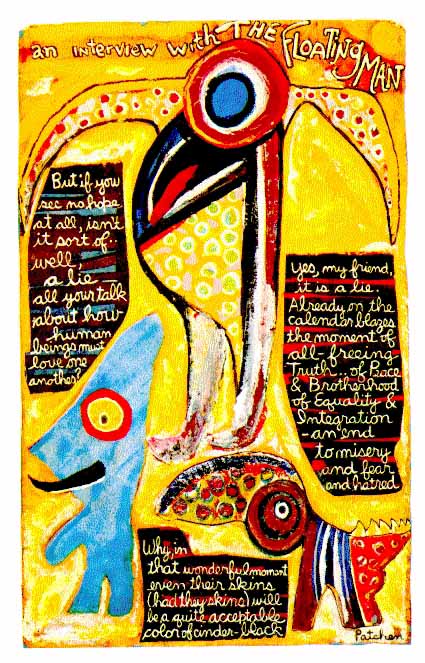
A lot of people are pointing to the excellent Ron Rege’s recent adaptation of Kenneth Patchen’s “The Snow is Deep on the Ground” over at PoetryFoundation.org.

What they’re not pointing to are Kenneth Patchen’s own “picture-poems,” many of which are painted and silk-screened in wild colors. Dig them:

COMICS WITHOUT PICTURES

Saturday, October 15th, 2005

“I learned so much using words and pictures and captions from some of the most concrete poets, because poetry is all about economy, and it’s about reducing things down, and you’re seeing how much freight you can actually give words. Plus, the great thing about comics which I miss when I’m writing prose, is knowing that I can pretty much guarantee that everybody will read every word. I can pace everything, every caption, every line of dialogue.”Neil Gaiman on Studio 360

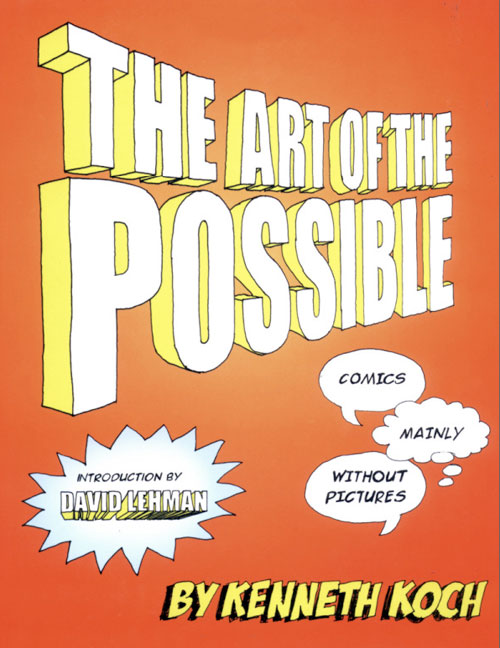
art of the possible: comics mainly without pictures by kenneth koch

Kenneth Koch was a poet who loved comics. Backwards City Review just reprinted some of his comics in their second issue. I tried desperately to find Koch’s posthumous collection, Art of the Possible: Comics Mainly Without Pictures, in a Cleveland Public Library, and turned up nothing. Then, lo and behold, Google Print has the introduction and a few pages online.

In the introduction, David Lehman writes about Koch,

“letting comics into his literary imagination followed not only from his love of the humorous, the whimsical, and the witty, but from an aesthetic point of view that could be charactreized as defieantly antiacademic.”

Koch saw no reason why Popeye shouldn’t enter the same conversation as T.S. Eliot. In one of Koch’s courses on imaginative writing at Columbia, the assignment was to go out, buy a comic strip, and without reading it, paste white paper over the balloons, and write your own dialogue.

“In 1992, Kenneth decided that not only could he borrow subject matter or adapt a narrative technique from comics but it might be possible to write poetry in a new form based on them.”

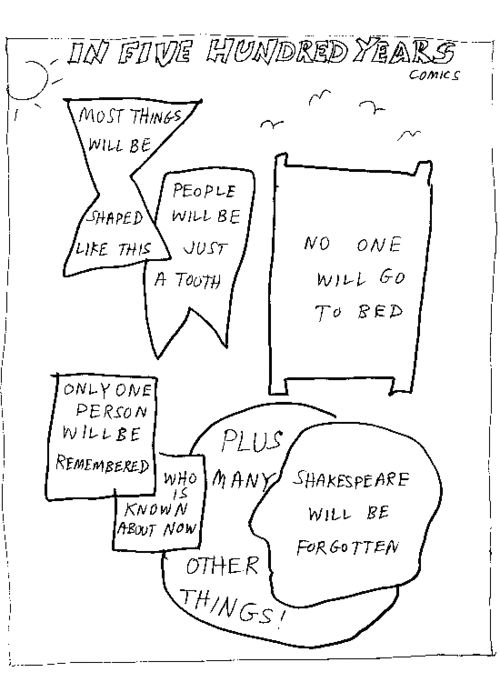
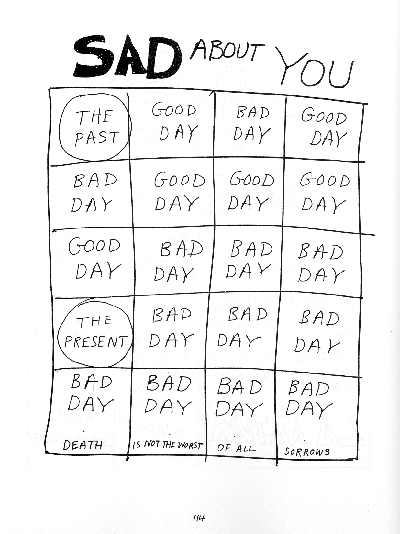
Some examples:

kenneth koch's art of the possible

kenneth koch's art of the possible

Link: