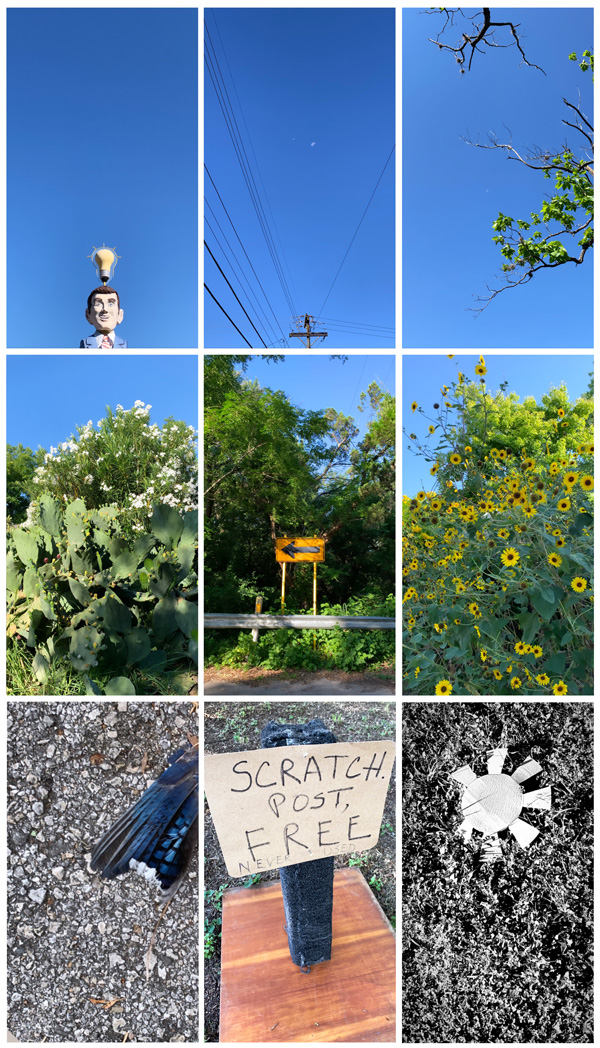
Our morning walks have been particularly good this past week. The Texas spring is still going strong, and it’s not too hot, not yet. I thought I’d make a “joiner” (from my Instagram stories) in the style of Hockney to celebrate.
Our morning walks have been particularly good this past week. The Texas spring is still going strong, and it’s not too hot, not yet. I thought I’d make a “joiner” (from my Instagram stories) in the style of Hockney to celebrate.
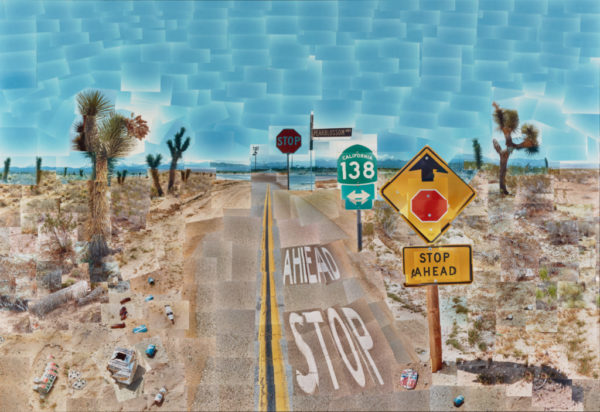
Here is David Hockney’s Pearblossom Highway, 11-18 April 1986, #2. Several people mentioned that they thought of Hockney when they saw my “Houses for Meg” — a huge compliment to me, as Hockney is one of my favorite artists. His “joiners” are my favorite works of his: huge photo collages made up of hundreds of individual 4×6″ prints.
In this video Hockney talks more about the piece and its origins:
(I had no idea it was originally commissioned by Vanity Fair to illustrate Humbert Humbert’s drive across the southwest in Lolita.)
Here’s a 1988 feature of him returning to the site and showing how he took the shots:
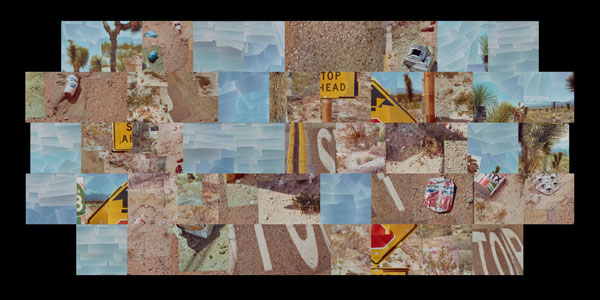
Oh, one fun thing: when you zoom in on the collage the Getty website serves up a bunch of different chopped up .jpegs. I downloaded them and put them in an ImageQuilt and hit shuffle:
Filed under: David Hockney, collage
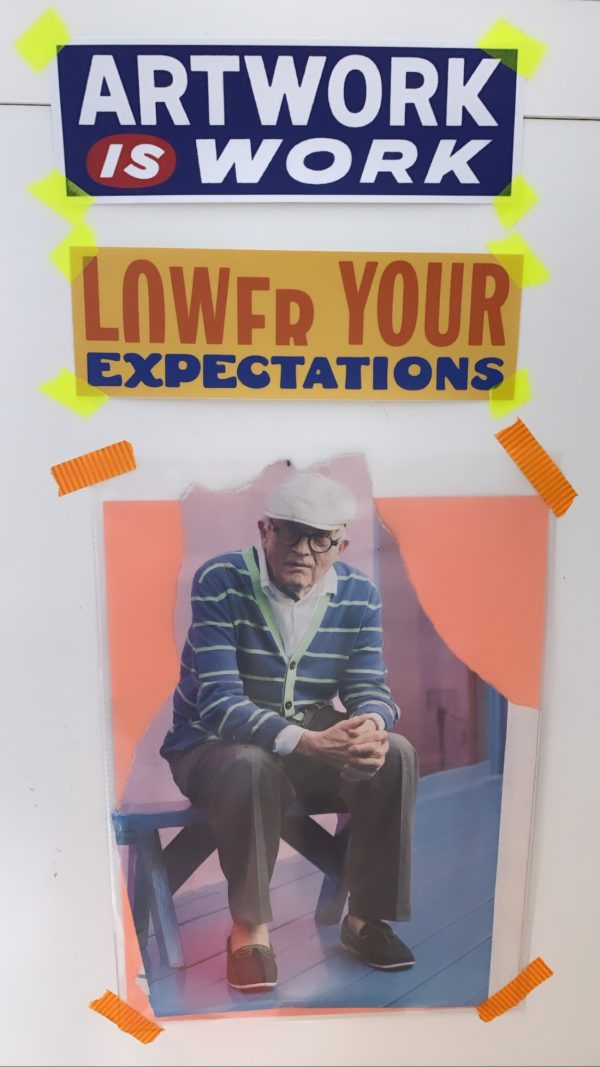
I’ve taped this picture of David Hockney back up in the studio. (Underneath these excellent bumper stickers.) It had a prominent spot on my bulletin board when I was writing Keep Going, and Hockney was one of the key figures I was thinking about when I wrote the book. (In the article the photo was clipped from, Hockney said, “I’ll go on until I fall over.” A motto worth stealing.)
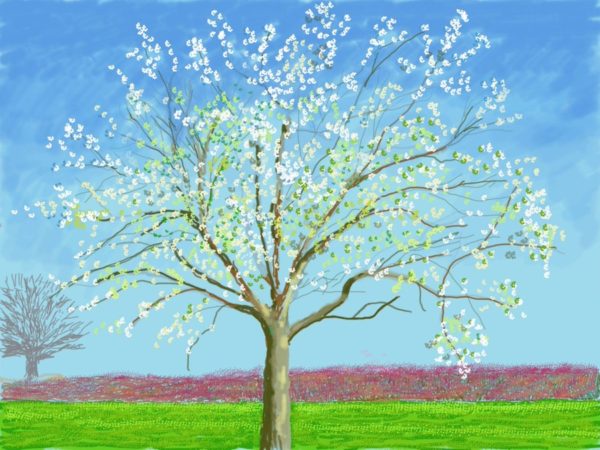
And so, it’s been great comfort to me to find out he’s still out there painting, in quarantine up in Normandy, sending “fresh flowers” from his iPad to friends, reminding us “they can’t cancel the spring,” even urging us to do our own drawing:
I would suggest people could draw at this time… Question everything…. I would suggest they really look hard at something and think about what they are really seeing…. We need art, and I do think it can relieve stress. What is stress? It’s worrying about something in the future. Art is now.
Hell yes. Go on until you fall over.
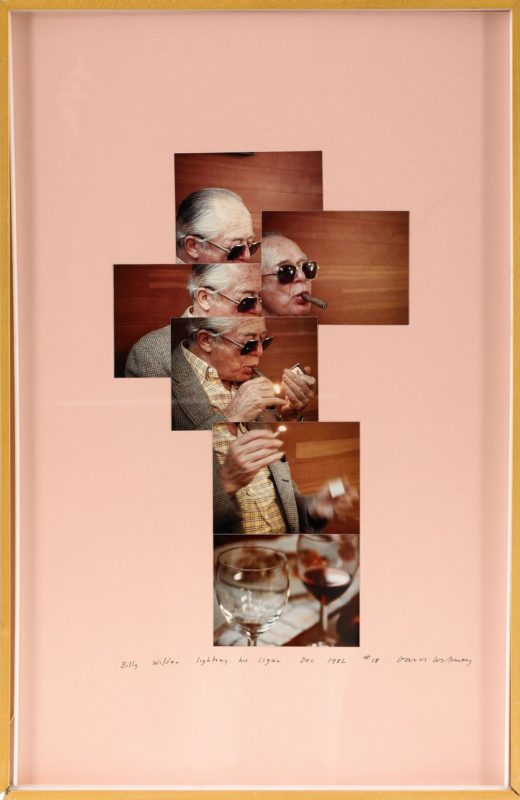
It’s director Billy Wilder’s birthday. Here’s a David Hockney “joiner” of him lighting up a cigar. (Collected in the book, Cameraworks.)
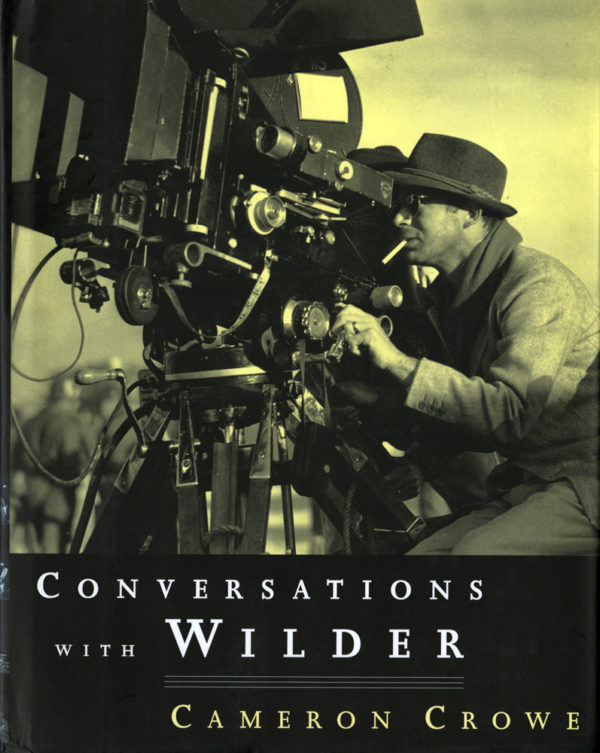
Other than watching all of his movies, another great way to get to know Wilder is in the book, Conversations With Wilder. In between Jerry Maguire and Almost Famous, Cameron Crowe spent a year interviewing his hero about his body of work. Crowe was just peaking and Wilder was retired and starting his nineties. The book chronicles their conversations and is full of hundreds beautiful black and white photos from his films and his life.
Some of my favorite Wilderisms:
Gary Kurtz, who produced the first two Star Wars movies, recalls learning about structure from Wilder:
“I took a master class with Billy Wilder once and he said that in the first act of a story you put your character up in a tree and the second act you set the tree on fire and then in the third you get him down,” Kurtz said. “ ‘Empire’ was the tree on fire. The first movie was like a comic book, a fantasy, but ‘Empire’ felt darker and more compelling. It’s the one, for me, where everything went right. And it was my goodbye to a big part of my life.”
Wilder also said, “An actor entering through the door, you’ve got nothing. But if he enters through the window, you’ve got a situation.” (Reminds me of John Le Carré: “‘The cat sat on the mat’ is not a story. ‘The cat sat on the dog’s mat is a story.’”)
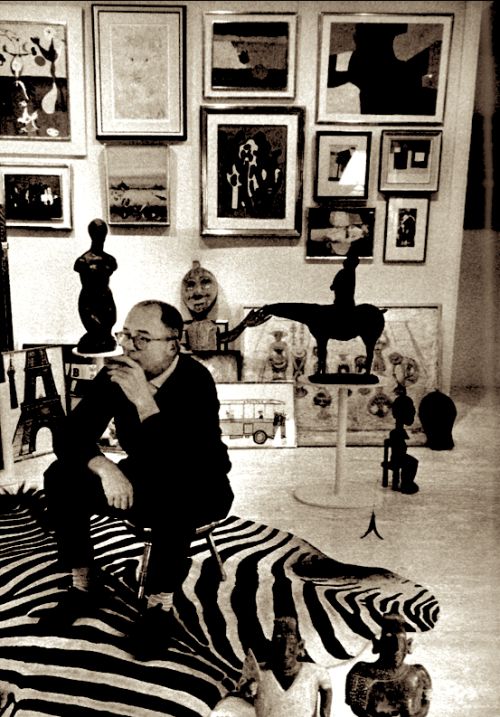
Wilder started collecting art when he was a newspaper man. (Freud once threw him out of his office because he hated reporters.) He told the Paris Review:
[I] only started collecting seriously when I arrived in America in 1934. Having worked every day of my life, and not owned horses or yachts or junk bonds, I put everything into art to decorate my walls. I wish I’d collected more and directed less. It’s been more fun collecting than making movies.
His advice: “Don’t collect. Buy what you like, hold onto it, enjoy it.”
“I bought a George Grosz painting for a carton of cigarettes in 1945,” he said.
In 1989 he sold his collection for $34 million.
“We’re discovering more and more,” he said, “and we know less and less.”
My favorite thing he ever said: “If you’re going to tell people the truth, be funny or they’ll kill you.”
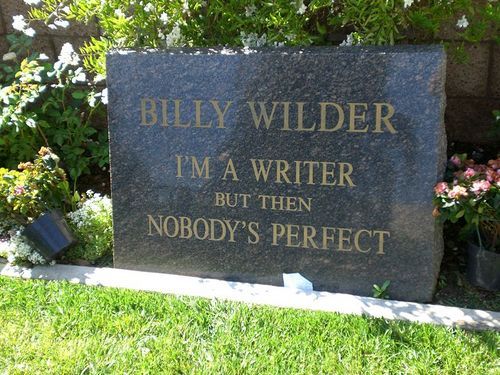
Here’s his gravestone:
“I’ll go on till I fall over.”
—David Hockney
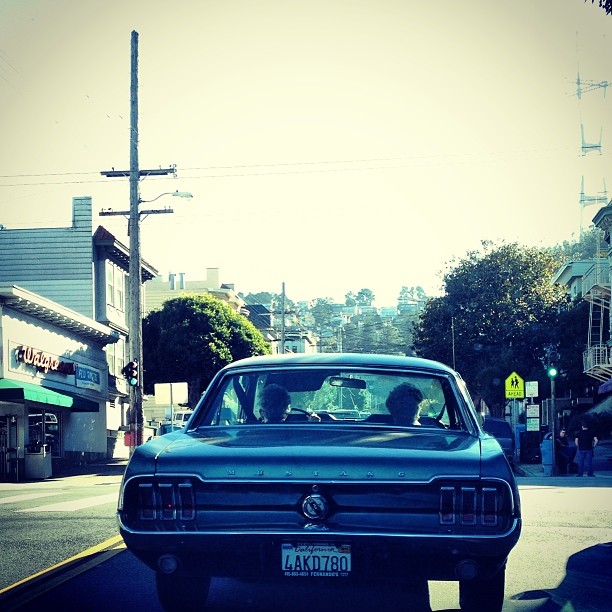
Two grannies in an ancient Mustang. I flew out to San Francisco this Thursday to be bombarded by the images made by David Hockney hanging at the de Young museum, but it’s this image, snapped on my iPhone, that sticks with me. Two ladies, advanced in years, cruising the future in a time machine from the past. (Someone asked director Paul Thomas Anderson why he shot The Master on 70mm film, and he said, “It just felt like a good spaceship for time travel.”)
Hockney has built his own spaceship for time travel out of his hands, his heart, and his eyeballs, and it’s fueled by his obsession with picture making. He’s up for any medium—watercolor, charcoal, high definition video, the Brushes app on the iPad—anything that helps him make pictures, and you can tell, regardless of the finished product, that you’re looking through those same eyeballs, moved by that same obsession.
You can’t help but be humbled in the de Young show—18,000 square feet of museum filled with the past decade or so of a 76-year-old’s output.
I’m 30. I can barely fathom working for another five years, let alone another 46 years.
The questions that have haunted me since I walked out of the museum: What is my obsession? What is my spaceship for time travel? What machine am I building now that will take me through the rest of my years?
This site participates in the Amazon Affiliates program, the proceeds of which keep it free for anyone to read.