Steal Like An Artist: The Book

BLOG ARCHIVES

Posts Tagged ‘diagrams’


MIND MAPS: PICTURES AND WORDS IN SPACE

Tuesday, July 15th, 2008

space and design

Pictures and words in space:

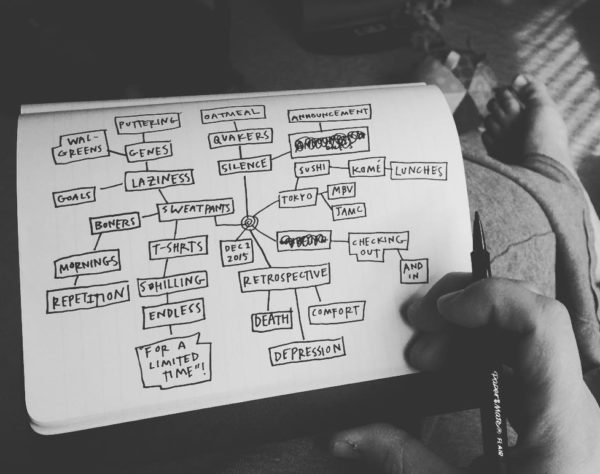
What I’m trying to do when I make a mind map: I’m trying to construct a 2-D memory palace on paper. By making notes in a non-linear manner, by arranging images and words in space, I can SEE connections that would otherwise be impossible with just words written in sequence.

linear vs. non-linear

I use mind-maps for several things:

1) Brainstorming

COMICS + INFORMATION DESIGN

Generating ideas, rather than just preserving them.

2) Taking notes on books

MINDMAP OF MUSICOPHILIA BY OLIVER SACKS

(Oddly, I have only attempted non-fiction, never fiction. Not entirely sure why this is.)

3) Taking notes on documentaries

mindmap of THE CORPORATION documentary (part one)

4) Recording meetings and events

Vizthink Austin June 18, 2008 Sketchnotes

5) Remembering conversations

See all of my mind maps.

Note: this post was a response to the Vizthink prompt, “In what unique way do you use Mind Maps?

E-mail this post

HOW TO WRITE A (GRAPHIC) NOVEL

Tuesday, July 3rd, 2007

Maureen McHugh has started to blog about the process of her novel-in-progress. She drew this hilarious chart to illustrate the steps:

"THE PROCESS OF WRITING A NOVEL" by Maureen McHugh

I have all but abandoned my graphic novel. If you were to plot my stage on the chart, it’d be “dark night of the soul,” only that dark night was months and months ago. Maybe last year. At this point, I’m way past it, and thinking of a new project, and thinking about how I might be able to actually put out a book-length comic.

I got a lot of advice when I was trying it the first time around. Some told me to just plot the whole thing out, and then draw. Do an outline. I was even told that with 20 pages of artwork and an outline, I might even be able to sell the thing.

This really made my guts churn. I’m with Maureen on this one:

I don’t outline. Outlining is for hacks. I believe in the difficult but fulfilling process of finding my novel as I write it; letting inspiration and the shape of what I’ve already written shape what comes next. Which is why I’ve thrown this novel out five times already.

My wife, who always has the best advice, if only I’d listen to it, suggested I just draw the whole thing out in my sketchbook, with nasty, sketchy thumbnails: the drawing equivalent to a “first draft.” Turns out this was the advice that I should’ve followed.

You don’t get a graphic novel much bigger than Craig Thompson’s Blankets. That was almost 600 pages, and his new one is going to be even bigger. Even bigger? How does he do it?

The answer is thumbnails.

“I draw the entire book in this loose ballpoint pen format and edit, before ever starting the final pages. BLANKETS was thumbnailed for a year.”

A YEAR of thumbnails. This makes me very hopeful.

My wife, again, came in with more advice: “You just need to FINISH something?” Ah yes, finishing. Getting to the last of Maureen’s stages, “It’s done and it sucks but it’s better than I thought.”

Craig Thompson, again:

…just…finishing things is a good idea! I had started a lot of projects before then where I’d get 20 pages into it and then I’d lose interest, then a couple months later start up a new project. I was never finishing anything. And so, whether Good-Bye, Chunky Rice has limitations or weaknesses or whatnot, just the fact that I finished it was a big deal, and it ended up being quite successful for that point in my life. So Blankets was a lot easier. Even though it was going to be a much bigger book, I was like, “Well, all I have to do is finish it.”

Because I’m into this Myers-Briggs gobblygook, I should note that my particular personality type, ENTP, is notorious for starting projects and then abandoning them once it figures out how they should be executed.

“ENTPs are less interested in developing plans of actions or making decisions than they are in generating possibilities and ideas. Following through on the implementation of an idea is usually a chore to the ENTP. For some ENTPs, this results in the habit of never finishing what they start.

The “secret to success” for me that my career book gives me?

“Prioritize, focus, and follow through.”

Trying.

E-mail this post

KEVIN HUIZENGA ON DIAGRAMMING

Wednesday, April 25th, 2007

adam_1.jpg

There was this job I had where I was working at a place called XPLANE, which was an illustration company that did these visual explanation things, and a lot of times that amounted to these diagrammatic/comics illustrations. That really got me interested in diagrams. And after thinking for a while about diagrams, the stories that I did while I worked there have a lot of diagrams in them, and that carried on through. I started collecting old science textbooks and so forth that had these nice illustrated diagrams. It made me realize that since I was in high school and Understanding Comics came out, I’ve always thought about the comics form. And something I started realizing recently is that we talk about comics being a mixture of image and text, but it really seems to me that a part of the way comics works is in this sort of diagrammatic space. You have a pictorial space, which follows certain pictorial norms, and then you have the text part of comics, which follows the syntactical structure of text and language. What comics does is it has this particular way of diagramming those things together using the panel unit and the word balloon as symbols for certain things. I really realized that that was the part of comics that appealed to me the most. When I look at other cartoonists, I think that they’re real pictorial cartoonists. They’re really interested in the image part of comics. And there are other cartoonists who are really interested in stories and the subjects we associate with literary storytelling like character, plot and so on. I realized the thing that interested me in comics is the way all of that stuff is diagrammed on the page and the way that you read it.”

- Kevin Huizenga, interview

Links:

E-mail this post

GRAPH A STORY WITH MR. VONNEGUT

Saturday, December 17th, 2005

Kurt Vonnegut’s master’s thesis in anthropology was rejected by the University of Chicago. “It was rejected because it was so simple and looked like too much fun,” Vonnegut writes. “One must not be too playful.” This excerpt from PALM SUNDAY, is the gist of his argument:

Anyone can graph a simple story if he or she will crucify it, so to speak, on the intersecting axes I here depict:

“G” stands for good fortune. “I” stands for ill fortune. “B” stands for the beginning of a story. “E” stands for its end.

A much beloved story in our society is about a person who is leading a bearable life, who experiences misfortune, who overcomes misfortune, and who is happier afterward for having demonstrated resourcefulness and strength. As a graph, that story looks like this:

Another story of which Americans never seem to tire is about a person who becomes happier upon finding something he or she likes a lot. The person loses whatever it is, and then gets it back forever. As a graph, it looks like this:

An American Indian creation myth, in which a god of some sort gives the people the sun and then the moon and then the bow and arrow and then the corn and so on, is essentially a staircase, a tale of accumulation:

Almost all creation myths are staircases like that. Our own creation myth, taken from the Old Testament, is unique, so far as I could discover, in looking like this:

The sudden drop in fortune, of course, is the ejection of Adam and Eve from the Garden of Eden.

Franz Kafka’s “The Metamorphosis,” in which an already hopelessly unhappy man turns into a cockroach, looks like this:

Have a look [at "Cinderella"]:

The steps you see, are all the presents the fairy godmother gave to Cinderella….The sudden drop is the stroke of midnight at the ball….But then the prince finds her and marries her, and she is infinitely happy ever after. She gets all the stuff back, and then some. A lot of people think the story is trash, and, on graph paper, it certainly looks like trash.

But then I said to myself, Wait a minute–those steps at the beginning look like the creation myth of virtually every society on earth. And then I saw that the stroke of midnight looked exactly like the unique creation myth in the Old Testament. And then I saw that the rise to bliss at the end was identical with the expectation of redemption as expressed in primitive Christianity.

The tales were identical.

UPDATE: Vonnegut goes over this again in A MAN WITHOUT A COUNTRY, which I’m currently listening to on audiotape (so no diagrams…but never fear: Gerry over at Backwards City has posted the chalkboard graph of “The Metamorphosis.”)

E-mail this post

THE COMBAT SUTRA

Saturday, November 12th, 2005

I was online researching material for a new story of mine and came across this stash of US Army Field Manuals.

Want to know the best way to kill a man? Or maybe how to load a grenade launcher? Never had time to brush up on parachuting tactics? Stress got you down in a combat situation? Need to snipe somebody?

It’s all there, your guide to life in the “theater of operations.”

On a side note, a few of the illustrations look alarmingly similar to positions you might find in the Kama Sutra:

E-mail this post