BLOG ARCHIVES

Posts Tagged ‘edward tufte’

MAGIC COINS AND TUFTE

Tuesday, August 21st, 2007

magic.jpg

[Teller's] definition of magic: “The theatrical linking of a cause with an effect that has no basis in physical reality, but that — in our hearts — ought to.”

The Science Times ran a great article on magic, perception and consciousness today, and with it came this cool photo set of Teller demonstrating a coin trick. It reminded me of the wonderful third chapter in Edward Tufte’s Visual Explanations — co-written with professional magician Jamy Ian Swiss — “Explaining Magic: Pictorial Instuctions and Disinformation Design,” that examines illustrations like this:

coins.jpg

Page 60:

In a difficult manipulation, the magician’s hands quickly exchange a silver coin for a copper one. Timing is crucial in magic, and the complex and rapid performance required for deft conjuring is not easy to illustrate. For this sleight, the author notes that the swift moves “must be done in a one-two-three up and down wave of your hand.” Depicting the action at a rate of two frames per beat, the multiple images flow over time and through space, just as a statistical graph records a time-series… Heavy arrows conduct the rhythm of images, while streamers in frames 382 and 384 indicate finer movements of fingers and coins. In this trick, like many others, small maneuvers of fingers are masked by larger hand movements. To expose the method, these drawings depict the hand tipped at varying angles toward the reader. Yet a slightly different angle of adjustment will assure that the audience sees only a silver coin magically transformed into a copper coin. Magicians are preoccupied with such viewing angles, which make the difference between a successful deception and a disastrous exposure. And so for illustrators: Are readers to see the produced effect or how to produce the effect, or both, and by means of what angles?

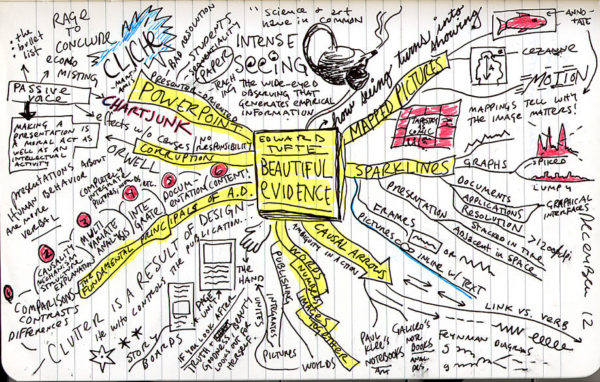
Speaking of Tufte, I was trolling one of my favorite sites, Peter Durand’s Center for Graphic Facilitation, and came across his notes from one of Tufte’s seminars:

Regular blog readers know how fond I am of mind-mapping Tufte: see Beautiful Evidence, Envisioning Information, and my thoughts on the relationship between comics and information design.

ENVISIONING INFORMATION

Sunday, July 8th, 2007

This is a mindmap I did of Edward Tufte’s Envisioning Information.

Not quite as fun for me as the one I did for Beautiful Evidence.

Mind-map of Edward Tufte's Beautiful Evidence

I wonder if that has something to do with the fact that this was my second time reading Envisioning Information? Taking notes on a book you’ve already read isn’t quite as fresh — you’re not as excited about the material, the new things you choose to single out.

One thing I did right, though, was make the map on both pages of my sketchbook, instead of just one. The bigger the paper, the more room you have for mapping.

COMICS & INFORMATION DESIGN, PT. 2: SYNTAX VS. STYLE

Friday, January 26th, 2007
“The cartoon style is sometimes good in explaining things; the words are right there with the illustration, complete text-image integration produced by the same hand behind both text and image. And the mind behind that hand has to have a good understanding of the content–usually–in order to produce the narrative illustrations. Of course readers don’t expect to see original scientific evidence reported cartoon-style; the cartoon style for serious evidence would compromise the credibility of the report.”

- Edward Tufte, Ask E.T. forum

* * *

It seems that most discussion about comics done by information designers is about the merits of the cartoon style – corporations using cartoons for training manuals or teachers using comics to appeal to teenagers, for example — than about the merits of what Tufte calls “the underlying syntax of comics.” Let us remember, by way of McCloud, that comics is a form, not a style — comics can look like The Gates of Paradise, or they can look like Marmaduke.

I like the word “syntax.” Comics is a language, with its own grammar, it’s own “patterned relations,” arrangements, and structures. Comics is also a type of special reading. So yes, it is true that information design can learn from cartooning’s “unity of style,” but what can it learn from, for example, the juxtaposition of “voiceover” narration with images and dialogue? What about recursive narration? What can we learn about reading and flow?

BEAUTIFUL EVIDENCE

Wednesday, December 13th, 2006

“Science and art have in common intense seeing…” - Edward Tufte

Mind-map of Edward Tufte's Beautiful Evidence

This is a mind map I did while reading Edward Tufte’s new one, Beautiful Evidence. I’ve been interested in this kind of “radial” note-taking ever since I read about “clustering” in one of Janet Burroway’s books on fiction. Graphic facilitators (like the cartoonist Drew Dernavich) do glorified doodling like this for a living.

Beautiful Evidence is, like all of Tufte’s previous books, fantastic. I enjoyed the chapters on picture/word integration and PowerPoint the best. The great thing about Tufte is the primary sources he uses, and in this book, he quoted everything from Galileo’s Starry Messenger, to a guide to spotting a concealed handgun, to Martin Amis’s The War Against Cliche.

Tufte’s sources come from all disciplines: his books are the most inherently integrated and interdisciplinary I’ve ever read. He also draws from great literature. In his Envisioning Information, he quoted from Italo Calvino’s Six Memos For The Next Millenium, which I’ve been hot for all year:

My working method has more often than not involved the subtraction of weight. I have tried to remove weight, sometimes from people, sometimes from heavenly bodies, sometimes from cities; above all I have tried to remove weight from the structure of stories and from language….Maybe I was only then becoming aware of the weight, the inertia, the opacity of the world — qualities that stick to writing from the start, unless one finds some way of evading them.

In other news, I had my first wedding anxiety nightmare last night, so you know it’s getting close. (Meghan’s been having them for weeks now.)

USING POWERPOINT FOR GOOD AND NOT FOR EVIL

Tuesday, June 20th, 2006
“Imagine a widely used and expensive prescription drug that promised to make us beautiful but didn’t. Instead the drug had frequent, serious side effects: It induced stupidity, turned everyone into bores, wasted time, and degraded the quality and credibility of communication. These side effects would rightly lead to a worldwide product recall.”

—Edward Tufte, “Powerpoint Is Evil.”

* * *

Nothing makes you want to off yourself like a chilly conference room and a dreadful Powerpoint presentation. Unfortunately, when I was in high school, nothing secured an easy A like a Powerpoint full of chartjunk. Tufte, again:

Particularly disturbing is the adoption of the PowerPoint cognitive style in our schools. Rather than learning to write a report using sentences, children are being taught how to formulate client pitches and infomercials. Elementary school PowerPoint exercises (as seen in teacher guides and in student work posted on the Internet) typically consist of 10 to 20 words and a piece of clip art on each slide in a presentation of three to six slides -a total of perhaps 80 words (15 seconds of silent reading) for a week of work. Students would be better off if the schools simply closed down on those days and everyone went to the Exploratorium or wrote an illustrated essay* explaining something.

In college, I smartened up, and realized that just because a Powerpoint was required, didn’t mean it needed to be bad. I began creating Powerpoints of pure images–no text at all. For my Summer Scholars project, I used scans from my rough drafts and sketchbooks as background while I spoke, and for my senior project fiction reading, I Powerpointed illustrations up on the screen while I read the story.

What I discovered, by my own observations, and then by reading Tufte’s devastating pamphlet, THE COGNITIVE STYLE OF POWERPOINT, was that certain information — statistics or charts or logical arguments or even prose stories — is all but ruined by the low-resolution, low-information output Powerpoint slide format, while visual images thrive (David Byrne took advantage of this in his book of Powerpoint art.)

Add to that, I’ve always wondered how you could do a cool author reading for a graphic novel. Turns out the answer is powerpoint. First, I saw the LOST BUILDINGS DVD project that Chris Ware and Ira Glass did for NPR. Ira read the story, while Ware’s images were projected on a giant screen. (See a preview.) Then I found out that for her readings, Alison Bechdel projects the comic panels from FUN HOME in Powerpoint, while reading aloud from the narration.

Comics + Powerpoint = Good?

*Bonus: Here’s Tufte on cartooning.