BLOG ARCHIVES

Posts Tagged ‘george saunders’

TEXAS BOOK FESTIVAL SKETCHBOOK

Sunday, November 4th, 2007

Yesterday Meg and I went to the Texas Book Festival. We were hoping to catch Shalom Auslander at the book signing tent, but he didn’t show up, so we walked downtown and got some Jimmy Johns and ate it on the lawn of the capital. Beautiful day. We finished up lunch and went to the House Chamber (which is pimped out beyond belief with the most comfortable leather chairs I’ve ever sat in) to listen to Tom Perrotta read:

TOM PERROTTA AT THE TEXAS BOOK FESTIVAL

After that, we went to see the always-fantastic-certified-genius George Saunders:

GEORGE SAUNDERS AT THE TEXAS BOOK FESTIVAL

That last panel is a response to a (kinda lengthy) question I asked in the Q & A: “You’ve written about Charles Schulz and Peanuts before. David Michaelis’s new biography questions whether Schulz was as good of a family man as we’ve been led to believe. You strike me as a genuine family man, and I detect the great theme of work vs. family in your writing. So what do you think is the relation between being a good artist and being a great family man, and which do you think is more important?”

That night, we walked downtown to see a screening of Little Children at the newly-reopened Alamo Ritz. I love Tom Perrotta, but he really seemed uncomfortable in the setting:

TOM PERROTTA AT THE ALAMO DRAFTHOUSE

All in all, it was a great day.

THAT ONE ODD DETAIL…THE ONE THING THAT ISN’T TYPICAL

Sunday, October 7th, 2007

George Saunders on significant details [via]:

“I remember reading somewhere in Hemingway—I think it’s in one of his stories—where a character who’s a writer is talking to his son, and he tells the kid a trick about description. He says: when you go to a Cuban marketplace, your first instinct is to catalog everything you see, especially the stuff that’s typical of a third-world market place. But his advice is to find the one thing that isn’t typical. The example he uses is of a cockfight, where one of the handlers is literally putting the chicken’s head in his mouth and blowing into the chicken, which—not surprisingly—enrages the chicken. And when you get that one odd detail, the whole marketplace will spring up in the reader’s mind. All of the commonplace things—you know, the stalls, the dirt path, the dead pigs and so on—will be supplied by your mind.”

GEORGE SAUNDERS WAS ON LETTERMAN LAST NIGHT

Friday, September 7th, 2007

george saunders on letterman

It was so bizarre watching him. Dave’s got great taste. (And George a good publicist, probably.) I’m just glad we got to meet him before all this “breakout tour” madness. Nicest, sweetest guy in the world. And brilliant. My favorite bit was when GS was talking about his past work experiences, how he was trying to live out his romantic, Hemingway-esque idea of working “lowly jobs,” like convenience store clerk, roofer, knuckle-puller in a slaughterhouse…

Letterman: But one learns from experiences that way, right?

Saunders: One does…don’t be an idiot!

And “Old Turkey Buzzard” cracks me up every time.

GEORGE SAUNDERS AT OBERLIN

Thursday, April 19th, 2007

GEORGE SAUNDERS AT OBERLIN


We drove out to Oberlin last night to see George Saunders read. I’d been looking forward to this for about a year, and I was praying to the weather gods that there wouldn’t be a giant snowstorm in Syracuse to keep him from getting to Cleveland. (He told us later that he was delayed, and missed a connecting flight, but it was an airline thing, not a weather thing.) Meg and I had a nice dinner at the Feve, and then we walked over to the Science Center. There weren’t any fun chemistry notes on the board in the lecture hall, but there was one of those little models with the wire and balls that you use to describe molecules…

Anyways. Big crowd. Lots of kiddies. First, he read the title story from In Persuasion Nation (here’s an MP3 from another reading). He said he wrote the story after watching a bunch of TV and realizing that a) advertising had began taking credit for everything good that happened in life (”Coke is Christ”) and b) that it had gotten really mean. Then he read from one of my favorites from Pastoralia, “The Barber’s Unhappiness” (here’s a hilarious MP3 of Tony Danza reading it). He said, “After you have daughters, you start realizing how misogynist the world is.” He wrote that story after watching a real old guy from the bus stop ogling women.

The readings were funny and warm and a little ornery. I think Meg laughed more than anybody, because up until that point, she’d only heard me read “Sea Oak” aloud to her in bed.

Then it was Q & A time. Somebody asked something about racial epithets. Somebody asked about motifs. He fielded questions like a patient, pro teacher, using them as springboards to talk about craft.

He joked that all the stories in CivilWarLand were the same: “Guy’s in a bad way. It gets worse.”

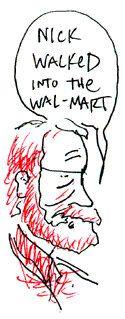
nicksaunders.gifHe joked about getting out from under the influence of Hemingway: “All my first stories went like this: Nick walked into the Wal-Mart.”

He did a hilarious high-voiced impression of Bill Buford’s method when he was fiction editor of the New Yorker: “Welll…I read a sentence…and then I like it…so I want to read another one!”

He said, “What you know is enough.”

He said good stories are “making language not suck.”

He plugged Don Barthelme’s great essay, “Not-Knowing.”

He described Joyce Carol Oates on her treadmill, thinking through her stories.

He recalled working in MS-DOS at his office, and using shift-F3 to avoid being caught writing on the job.

He outlined an editing method he uses with his students. First, he gives them 500 words of crap. Then they take a few minutes and cut 20 words. Then they take a few more minutes and cut 50 words. They do this a few more times until they have the crap whittled down to 200 words. The excercise is about finding voice in the appropriate “Prose Weight.”

Somebody asked, “What have you learned about the role of solitude in a writer’s life.” He said, “I never had any.”

Lucky me, I got the last question. I asked him, “What have you read lately that’s knocked you out?”

He said Susan Sontag and Joan Didion, two women he had never read before.

Then he started listing his old favorites. “Stuart Dybek?” I nodded. “Oh, you know him. How about Isaac Babel?” I nodded. “Stan Schwartz?” I shook my head. “Oh, no? That’s good, because I just made him up.” The room roared.

There was a long line outside to get books signed. We finally got to shake hands and say hello. “So, I take it you two are writers.” I said I was a cartoonist, and Meg was an architect. “Smart man!” he said. “You’re the guy who’s read everything.” I said, “No, only your reading list.”

Then we talked about Vonnegut. I mentioned the Amazon piece, and he said he’d re-worked the ending and that it would be in a new book soon. (I’m wondering if that new book is The Braindead Megaphone.) He said he just had a piece in the New York Observer proposing a National Vonnegut Day.

Then, we talked a little bit about Lynda Barry and how awesome she was. He said she came and taught at Syracuse and that she’d given him these really interesting articles on how the brain processes lyric poems, short stories, and jokes in the same way, as in, after you hear them, the brain runs back through them and gets its satisfaction from their shapeliness. She also told him about how they’d studied artists and creative people and figured out their patterns of childhood play. Next time I’m working, I’ll have to try to dig those up.

We said our goodbyes, and on the way home, Meg and I talked about how nice a guy he was, and how much we loved going to readings like this.

cowboyboots.gif

GENIUS!

Wednesday, September 20th, 2006

“…genius involves the original formation of a new style….it ain’t whatcha write, it’s the way atcha write it.”

- Jack Kerouac, “Are Writers Made or Born?”

talentisnotgenius.gif

George Saunders’ response to his MacArthur Genius Grant? “I feel smarter already.” Dig also: David Macaulay, whose The Way Things Work was one of my favorites when I was a kid.
You know who else should be thrown a big handful of money? The National. Last night I listened to Alligator and Sad Songs For Dirty Lovers on the turntable back-to-back.

Those guys destroy.

MORE THOUGHTS ON MAKING A MOUNTAIN OUT OF GAG STRIPS

Friday, June 30th, 2006

m3.jpg

“Comics get to the essence of something quickly and efficiently….They distill and refine, they don’t necessarily tell stories or have a message.”

Mark Newgarden in an interview, and “The Little Nun” from We All Die Alone

* * *

Of course, they can tell stories. The trick is just a million different combinations of words and images and panels.

I’m still a bit obsessed with this idea of a novel constructed out of gag strips. The gorgeous thing about a gag strip is that it doesn’t have to be funny, it just has to have a punchline. And the good news is that a decent novel chapter does the same thing: there’s a rise and fall and then a good punchline at the end to give you some kind of closure, but also get you to turn the page and read the next one. What happens next?

Here’s Kurt Vonnegut in A Man Without A Country:

It’s damned hard to make jokes work. In Cat’s Cradle, for instance, there are these very short chapters. Each one of them represents one day’s work, and each one is a joke. If I were writing about a tragic situation, it wouldn’t be necessary to time it to make sure the thing works. You can’t really misfire with a tragic scene. It’s bound to be moving if all the right elements are present. But a joke is like building a mousetrap from scratch. You have to work pretty hard to make the thing snap when it’s supposed to snap.

There’s a reason why Chris Ware’s Acme Novelty Library is way better than Jimmy Corrigan. Acme is still Ware’s melancholy world, but Rocket Sam and Big Tex have that snap—that punchline of a good gag strip. (Maybe this is because Ware’s art trumps his writing, and a good deal of the gag strip has to do with the visual tricks involved…)

Now: wouldn’t you love to read a graphic novel’s worth of Mark Newgarden’s “Little Nun” gag strips? (You can check out more of them in McSweeney’s 13 or We All Die Alone). All it would require is continuity. Some kind of journey or quest. The Little Nun could just take a trip across America. Maybe she could meet other nuns. Gather a crew. Fall in love or something. It could go on for something like 100 pages. It’d be so easy to draw, you could just churn out the pages. And think of the serializing potential! It’d be spectacular.

Eventually, I think The Complete Peanuts will read something like this. George Saunders wrote in his Shulz obit:

…try to imagine, say, three kids sitting against the side of a suburban house on a summer afternoon….If these characters are allowed to grow up and leave the suburban lawn and get jobs and fall in love, this is called a novel, and you, the creator, are called a novelist. If the imagined children are not allowed to grow up but are confined to the suburban lawn, where they continue for the next 50 years to be rich manifestations of their creator’s psyche, and if this creator’s imagination is supple and energetic enough never to tire of reimagining the children on the suburban lawn and never to make us tired of observing the children on the suburban lawn, this is called “Peanuts.”

But if you read them all together, doesn’t the collected work take some kind of shape, some rise and fall of action that resembles a narrative? Some continuity that resembles something the steps in a journey? Certainly it presents a world.

Or is it the ending that we demand, the closure, the change, the move to point B from point A?

IT’S JUST A SERIES OF GAG STRIPS WRITTEN IN A SECRET CODE

Saturday, June 24th, 2006
“To construct a picture-story does not mean you must set yourself up as a master craftsman, to draw out every potential from your material —often down to the dregs! It does not mean you just devise caricatures with a pencil naturally frivolous. Nor is it simply to dramatize a proverb or illustrate a pun. You must actually invent some kind of play, where the parts are arranged by plan and form a satisfactory whole. You do not merely pen a joke or put a refrain in couplets. You make a book: good or bad, sober or silly, crazy or sound in sense.”

—Rudolph Töpffer, Essay on Physiognomy, 1845

* * *

Anything new: you wonder what to call it. I’m calling mine a graphic novel for the marketers. But what it really is is a Cartoon Novel. Or a novel-in-cartoons. Or just a book.

Kurt Vonnegut said he wrote Cat’s Cradle as if each chapter were a joke. Nathaniel West said he originally pictured Miss Lonelyhearts as a novel in comic strips.

I’m trying to write mine as if each page is a gag strip. Only the gags build into a story. And lots of them aren’t funny at all.

Peter Orner’s excellent new book is kind of like that. Each part is a little episode. And the episodes build into something big.

Whatever it is, it’s a book. This, I think, is a revelation.

* * *

htpg13.GIF
- James Kochalka, quoted in Dylan Horrocks’ “The Perfect Planet: Comics, Games, and World-Building.”

* * *

George Saunders says that as a young boy, he felt the language in Esther Forbes’ Johnny Tremain was a code he could break, “a code that turned out to be more accurate and expressive than the one we all use to slog through normal life.” And breaking this code suggested to him that he might be able to come up with his own code, “a premonition that my complicated feelings about life could be subjugated to that quest, which has turned out to be true.”

People talk about voice and style, and I have no clue what they’re talking about. “Find your voice!” they say.

Screw that. I’m working on my secret code.

BRAND ME, PLEASE

Monday, May 15th, 2006

“…with his third collection of stories, “In Persuasion Nation,” he’s peddling a line of signature goods. Expertly made, unmistakably his, they’ll be consumed with gusto by the loyal customers who enjoyed “CivilWarLand in Bad Decline” and “Pastoralia.” It’s the kind of ironic twist he delights in: George Saunders, sworn enemy of commodification, is in danger of becoming a dependable brand name.”

* * *

Artists out there: there’s a lesson to be learned. You study the system, you figure out how it works, then you use your newfound knowledge…

Name awareness. Identification. Purpose. Packaging. Marketing. Graphics. Image. Distribution. Quality assurance. Cumulative impressions. Remembrance. Relationship. Word of mouth. Lifelong customers.

If the customer has heard of us, we’ve done our job.

Is it okay to use the tools of the unholy for the holy? Or is the key to realize that there is no holy or unholy, only tools?

“Me and my wife are Buddhists,” Saunders has said, “and one of the things they teach is that it’s only your limited point of view that makes things holy or unholy.”

Brand-loyalty: isn’t it the dream of every artist?

* * *

UPDATE: Meg sent me this article later this morning, “Building A Brand With A Blog.”

WHEN WILL I BE BLOWN UP?

Saturday, April 22nd, 2006

In Persuasion Nation The Brief History of the Dead : A novel The Big Fat Kill (Sin City, Book 3: Second Edition) The Best of Little Nemo in Slumber Land

Our tragedy today is a general and universal physical fear so long sustained by now that we can even bear it. There are no longer problems of the spirit. There is only one question: When will I be blown up? Because of this, the young man or woman writing today has forgotten the problems of the human heart in conflict with itself which alone can make good writing because only that is worth writing about, worth the agony and the sweat. He must learn them again.

—William Faulkner, “Nobel Prize Acceptance Speech”

I got my copy of George Saunder’s In Persuasion Nation in the mail a couple days ago, but I’ve found it really hard to get into, because I’ve already read most of the stories elsewhere. (”CommComm“, “Adams“, “Bohemians”, “The Red Bow,” “Christmas,” “93990,”…if you’ve got the Complete New Yorker you’re halfway there.) It’s like an album of previously released singles. The new website has a bunch of goodies on it, including a chapbook of non-fiction and an MP3 of Tony Danza (!) reading “The Barber’s Unhappiness.”

I’m also listening to Kevin Brockmeier’s THE BRIEF HISTORY OF THE DEAD. He got the idea for the novel from the epigraph of one of my favorite books in high school: Jame Loewen’s LIES MY TEACHER TOLD ME. Here’s a list of songs about death that Brockmeier likes, and the original story from the New Yorker.

I am still very excited for the new Walkmen album.

Madame Bovary Mind\'s Eye: An Eye of the Beholder Collection McSweeney\'s Issue 19 (McSweeney\'s Quarterly Concern) The Self-Publishing Manual: How to Write, Print, and Sell Your Own Book, 14th Edition

TECHNICAL CONCERNS ARE MORAL CONCERNS

Wednesday, December 28th, 2005

After reading the article on Philip Pullman and the morality of fiction in The New Yorker, I was reminded of the following bit from a George Saunders interview posted on Maud Newton a while back:

…as for the craft: I think it’s about sentences. You write: “Hal, as usual, was talking a lot of right-wing bullshit that made no sense.” Okay, fair enough. But now, in revision, you feel that the sentence lacks specificity. Forget about politics, truth, fairness, all that — it’s dull because it’s vague. The question is: What does he say, exactly? And what does his face look like as he says it? And who is he saying it to? And what do they think? And what is Hal thinking as they look at him? Does he feel he’s being judged? Is his stutter getting worse, filling him with rage? Is the father of the Swiss girl there, looking appalled at Hal’s stutter? Is the Swiss girl playing nervously with her braid, suddenly ashamed of Hal? So you have to cross out “talking a lot of right-wing bullshit” and give Hal something to say, in a specific voice. And now suddenly you’re really paying attention to Hal, which means you’re being compassionate. You’re actually curious about what Hal is all about, instead of pre-knowing what he’s about.

What I’m saying is, all moral concerns in fiction reduce to technical concerns. And technical concerns drive us towards specificity and detail and truth.