Steal Like An Artist: The Book

BLOG ARCHIVES

Posts Tagged ‘paper’


DRAWING ON SHEETS (INSTEAD OF SKETCHBOOKS)

Friday, April 24th, 2009

edward tufte care package
Edward Tufte care package

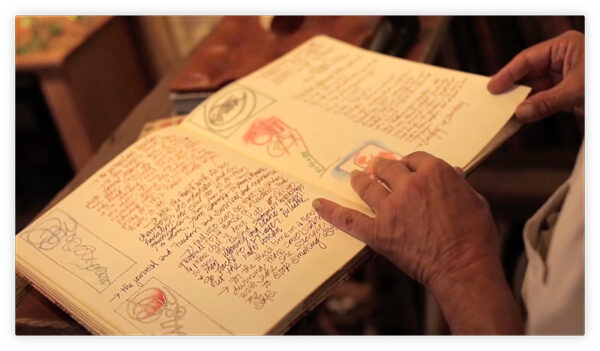
I’ve thought recently about abandoning sketchbooks in favor of single sheets of paper, index cards, legal pads, and binders: sketchbooks are convenient for carrying around, but they’re really hard to scan, and they don’t afford remixing or reshuffling pages. I want to make little books that are more like collages, without destroying the pages by using adhesive on them. I just need a little portfolio with plastic pages…something like what Lynda Barry has in this picture. Or like this. I could also just do the three-ring binder with page protectors. Any suggestions?

I’m thinking about this because Michelle Malott wrote in and asked me what kind of paper I used for my mind maps. My usual reply would be, “Whatever’s around,” but recently I’ve been a big fan of Edward Tufte’s graph paper he sells on his website. It’s acid-free, really nice and smooth, and has a “ghost” grid on it, which makes it easy to lay things out. I’ve been using the regular 8 1/2 x 11 sheets, saving up the 11 x 17 sheets for something really awesome.

You can see the results from my last two maps:

Tufte sent me a big batch of the paper after seeing my Beautiful Evidence and Envisioning Information maps. Tufte’s a “hero thinker” of mine, so it was a thrill to get mail from him. Come to think of it, I’ve had good luck getting mail from my heroes. Love how classy this little card is:

edward tufte compliments

If you don’t know his work, you should.

E-mail this post

THE HEROES IN THIS BATTLE ARE DUMPSTER DIVERS AND PACKRATS

Tuesday, September 5th, 2006

Making Comics: Storytelling Secrets of Comics, Manga and Graphic Novels Double Fold: Libraries and the Assault on Paper (Vintage) Persepolis: The Story of a Childhood
Louis Riel: A Comic-Strip Biography The Freddie Stories Esquire\'s Things a Man Should Know About Marriage: A Groom\'s Guide to the Wedding and Beyond

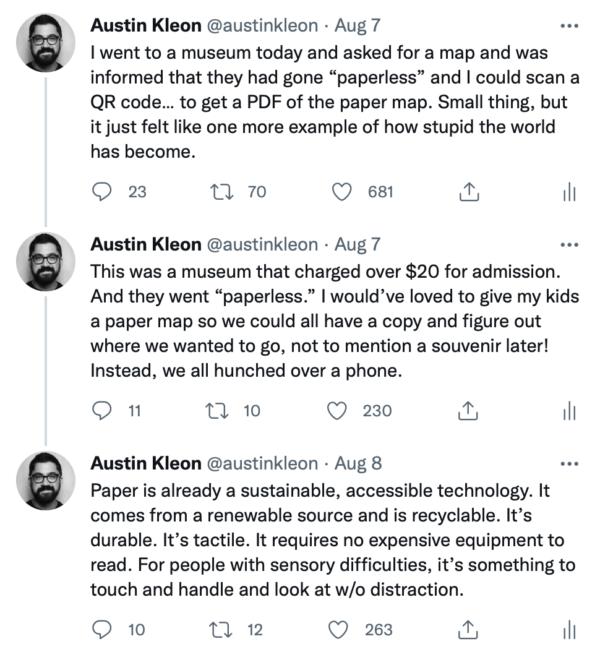
I’ve been thinking lately about paper.

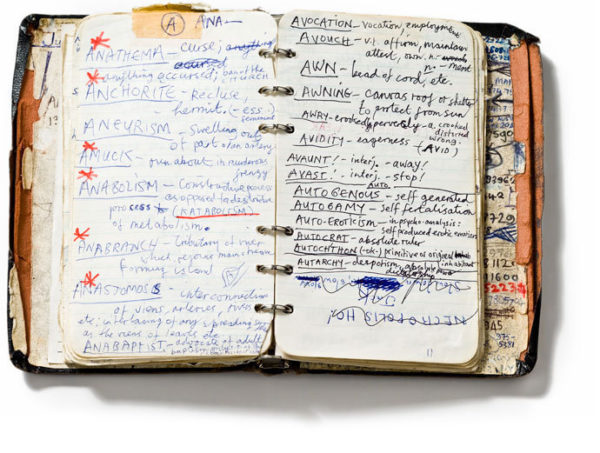
After the Great Powerbook Crash of ’06, I’m growing ever more skeptical of digital media. Even though I do a great deal of my drawing on the computer, I’m rediscovering the joy and permanence of filling notebooks.

And ever since we had to cancel our subscription to the New York Times, it’s been a real treat to head over to the future parents-in-law’s to dirty up my fingers with newsprint.

* * *

What else got me thinking about paper?

Cartoonist Kevin Huizenga (who has a new book coming out soon) had a great post a few days ago about Bill Blackbeard, the history of archiving Krazy Kat strips, and Nicholson Baker’s Double Fold. Here’s the jacket copy from Double Fold:

Since the 1950s, our country’s libraries have followed a policy of “destroying to preserve”: They have methodically dismantled their collections of original bound newspapers, cut up hundreds of thousands of so-called brittle books, and replaced them with microfilmed copies — copies that are difficult to read, lack all the color and quality of the original paper and illustrations, and deteriorate with age. Half a century on, the results of this policy are jarringly apparent: There are no longer any complete editions remaining of most of America’s great newspapers. The loss to historians and future generations is inestimable.

In my brief tenure working in a public library, I’ve witnessed this depressing phenomenon first-hand. Due to budget restrictions, libraries are increasingly being run as retail chains (like everything else in this country, the pull towards privatization is strong), and so, in a bid for more space, the mantra is if you can get it online, drop the paper copies (so we can make room to put in more computers for tax payers to check e-mail and look at porn.)

The problem is, the majority of online references include no layout or graphics. So yes, you can read that Plain Dealer article from 5 years ago, but you won’t see any photography or the graphics that went with it. (Some databases, like the New York Times Historical Database or say, The Complete New Yorker, remedy this problem beautifully by using PDF technology.)

The only reason Krazy Kat survived this coup was through the efforts of a dedicated fan who clipped each and every color strip and donated his run to a historical society in Wisconsin.

Otherwise, the strips would be rotting in a dumpster somewhere.

* * *

Cool fact: 2 hours away, the Cartoon Research Library at Ohio State has six tractor-trailers worth of old newspapers that Bill Blackbeard sold to the university.

* * *

I’m researching a good deal of The Book through microfilm, and therefore, spending a lot of time squinting.

The nice thing about paper? It’s ridiculously high-resolution. No squinting required. And you can stick it in a big file folder to sift through later.

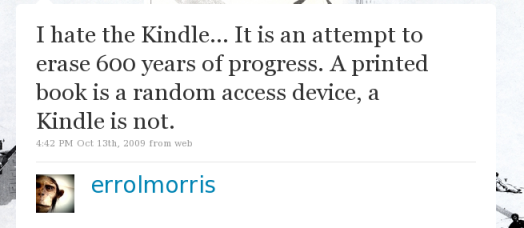
Edward Tufte, in his brilliant tirades against PowerPoint, has repeatedly championed this triumph over digital media:

Overhead projectors and PowerPoint tend to leave no traces; instead give people paper, which they can read, take away, show others, make copies, and come back to you in a month and say “Didn’t you say this last month? It’s right here in your handout.” The resolution of paper (being read by people in the audience) must be ten times the resolution of talk talk talk or reading aloud from bullet lists projected up on the wall. A paper record tells your audience that you are serious, responsible, exact, credible. For deep analysis of evidence and reasoning about complex matters, permanent high-resolution displays are an excellent start.

So yeah. Let’s hear it for paper!

E-mail this post