
Above: a page of map symbols of topography from a world atlas. Below: Saul Steinberg’s “Country Noises.” 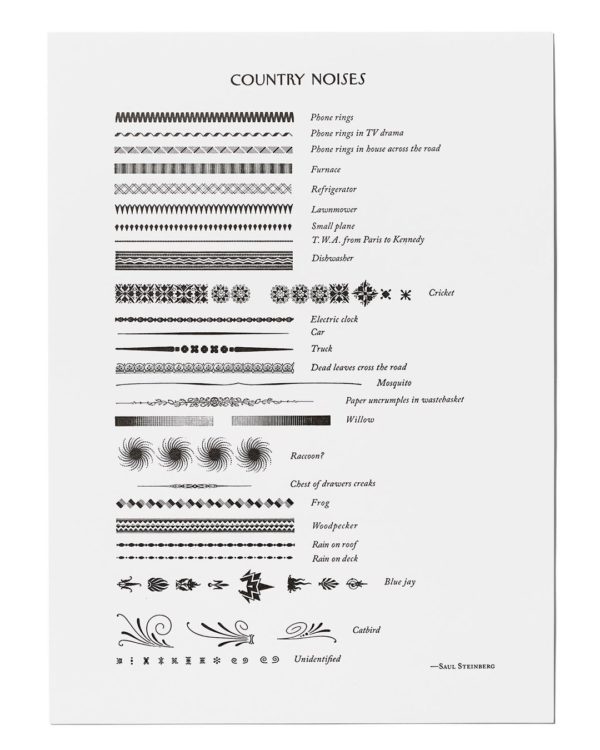
And in today’s mail: Brian Dillon’s latest, Affinities.
“The world keeps showing me these pictures.”
Filed under: convergences
Above: a page of map symbols of topography from a world atlas. Below: Saul Steinberg’s “Country Noises.”
And in today’s mail: Brian Dillon’s latest, Affinities.
“The world keeps showing me these pictures.”
Filed under: convergences
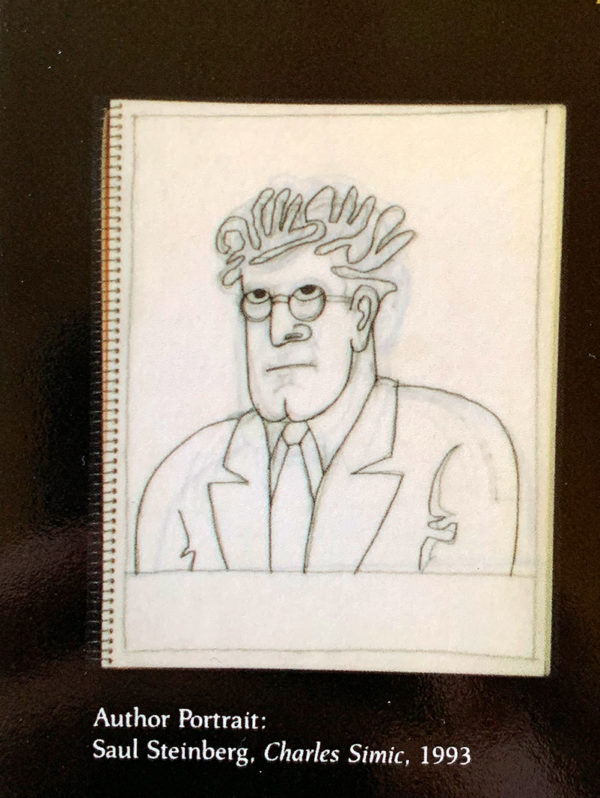
The poet Charles Simic died. Here is the author portrait on the back of his book, The Monster Loves His Labyrinth: Notebooks, drawn by Saul Steinberg in 1993.
Simic said walking around New York with Steinberg was as delightful as looking at one of his drawings. They became friends towards the end of Steinberg’s life. (Steinberg died in 1999.)
Simic wrote at least 3 pieces about his friend, all of which shed good light on both the subject and the author: in 2005, a brief review of Steinberg at The New Yorker; in 2006, his introduction for Saul Steinberg: Illuminations, the catalog for a wonderful show I saw on my honeymoon; and in 2012, a long review of Deidre Bair’s biography, “The Loves of Saul Steinberg.”
I get the sense that when Simic wrote about Steinberg he was also writing about himself. (I mean, when isn’t this true? But still.) Simic and Steinberg were both post-war immigrants — from Belgrade and Bucharest, respectively — who came from cultures where west and east collided and the old world clashed with the new.
“Saul said that the reason we understood each other perfectly was that we were both reared in what he called ‘the Turkish delight manner.’” Simic writes about his home in Belgrade, where “in every room, the Ottoman and Austro-Hungarian Empires still fought their battles,” and how his native city was surrounded by countryside in which “one could literally take a pick in what century one wanted to spend one’s holidays.”
So they were both artists unstuck in time and place. In Simic’s obituary, Dwight Garner writes that his “work combined a melancholy old-world sensibility with a sensual and witty sense of modern life,” and Simic basically said the same of Steinberg:
He was between worlds, in more ways than one, which is not a bad place to be for someone who wants to elude being classified as this or that. With a lightness of touch that concealed his keen intellect, the depth and complexity of his ideas, he reminds us that the fantastic and the natural, the comic and the serious all belong together. Since most immigrants’ lives, as a matter of course, resemble the Theater of the Absurd, taking such contradictions in stride was perfectly understandable on his part. For many of us, the story of exile ended up being a philosophy of laughter.
Simic said “America appealed to Steinberg as a collage of styles,” which suited him because he already came from a place “so rich in contradictions.” Simic thought of Steinberg as a “comic philosopher,” whose work showed us that “only a comic sensibility can grasp the character of our country and our national myths.”
Simic also said if you couldn’t place Steinberg as an artist, “a look at the writings of Rabelais, Cervantes, Gogol, and Mark Twain may provide a better answer than a visit to an art museum.” (Steinberg himself called himself a “writer who draws,” and even made a piece called Library, which includes a wooden copy of Gogol’s Nose.)

Simic highlighted another thing that about Steinberg the Immigrant: how his displacement made him see the world with fresh eyes.
“He walked out of his front door with eyes wide open as if he had just arrived from a foreign country, rediscovering the street and the city where he lived for many years.”
Being an immigrant made one into a child again, Steinberg said. A child who talked funny and noticed things natives never did. Beauty in America came as a surprise; it seemed to be an accident, and was unlike any experience of beauty he’d had before.
Steinberg did what all great artists do: he made the familiar strange, gave you a new way to look at the everyday.
In his essay, “How To Write a Charles Simic Poem,” in Equipment for Living, the poet Michael Robbins says Simic did the same, “taking Viktor Shklovsky’s concept of defamiliarization (ostranenie) literally.”
Robbins then quotes the first lines of “Fork,” a poem he teaches his students “as an example of the work poetry must do”:
This strange thing must have crept
Right out of hell.
It resembles a bird’s foot
Worn around the cannibal’s neck.
“Forget about self-expression, kid,” Robbins writes. “Learn to see the monster on the dinner table.”
I need to stop at some point, so I’ll end with a quote from the end of Simic’s Paris Review interview when he was asked about how his poetry reminds the reader of the pleasure of the ordinary:
Sausages sautéed with potatoes and onions! It’s also highly advisable to have a philosopher or two on hand. A few pages of Plato while working on a baked ham. Wittgenstein’s Tractatus over a bowl of spaghetti with littleneck clams. We think best when we bring opposites together, when we realize that all these realities, one inside the other, are somehow connected. That’s how the wonder and amazement that are so necessary to both poetry and philosophy come about. A “truth” detached and purified of pleasures of ordinary life is not worth a damn in my view. Every grand theory and noble sentiment ought to be first tested in the kitchen—and then in bed, of course.
Emphasis mine. RIP.
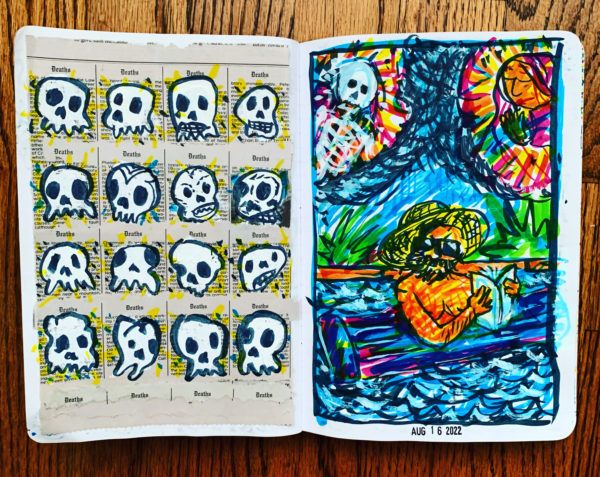
In Latin, the term “ex-voto”, is described as: a votive offering of thanks to a sacred entity for a miraculous act.
I first heard of ex-voto when researching the cartoonist Saul Steinberg’s bicycling habit. From the year 1992 in his chronology:
August, tells Aldo Buzzi that he fell off his bicycle but was not seriously hurt. “In my mind I see the disasters I avoided—teeth, bones, eyes—and I understand the concept of the Ex-Voto.” He makes an apotropaic drawing…
“Apotropaic” means “supposedly having the power to avert evil influences or bad luck.”
Here’s that drawing:
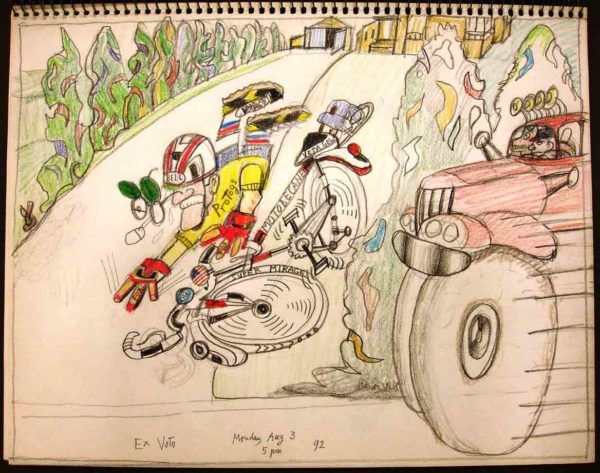
Note the brand names on all of his gear. In another letter to Aldo Buzzi, he wrote about his cycling commute:
Early in the morning, then, I’m on the bicycle to Amagansett, all of it uphill, and for a little bit along the ocean, etc. The return trip, downhill, much quicker. I wear a plastic helmet due to the danger from local yokels in their trucks, who hate cyclists and drive too fast and too close.
Here’s another ex-voto drawing of him on his bicycle from 1992:
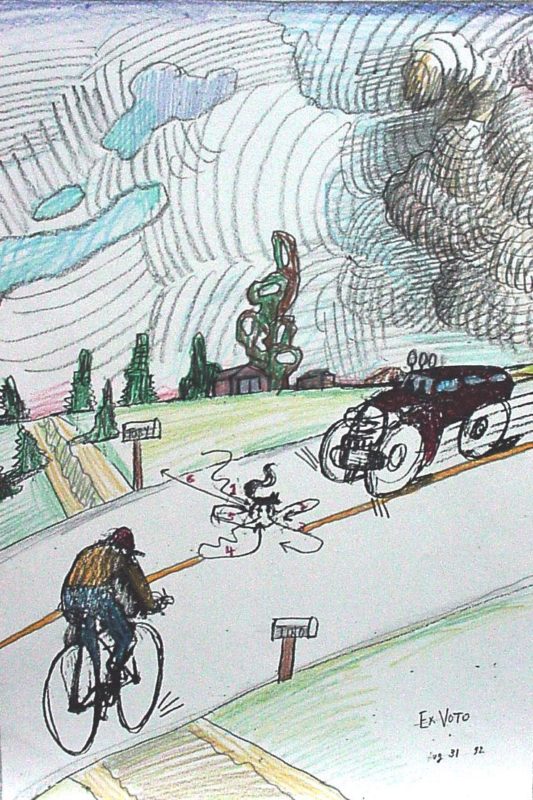
I’m not sure when Steinberg first became inspired by ex-votos. There were votive paintings in his native Italy, but he also made several trips to Mexico, first in the late 40s with Hedda Sterne, who was down there hanging out with the great Miguel Covarrubias and others. He first started making his own around 1983.
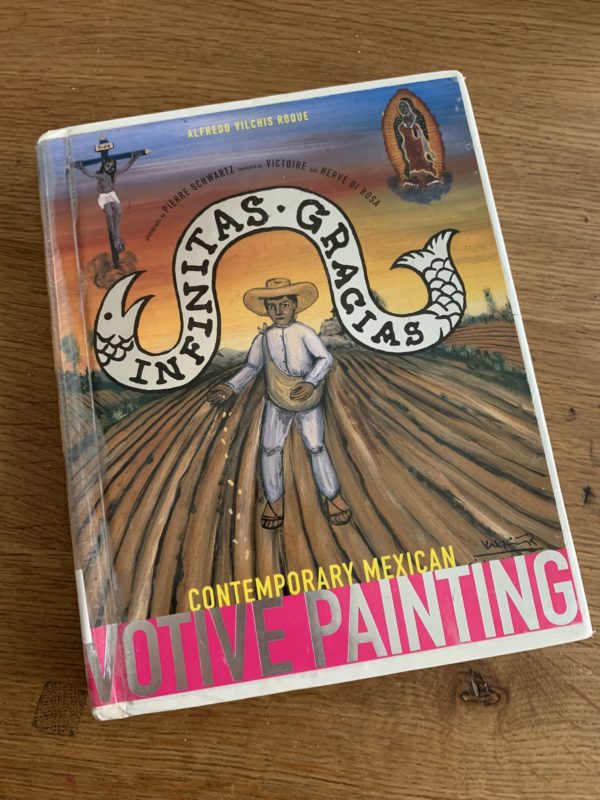
Not too long after I saw Steinberg’s drawings, I was at the library and came across this book of contemporary Mexican votive paintings by Alfredo Vilchis Roque and his three songs, made from the 30s to the present day. The book is divided up into sections based on subject matter: “Parenthood,” “Relationships,” “Emigration,” “Urban Violence,” “Illness,” etc. My favorites were the paintings thanking saints for not getting caught cheating:
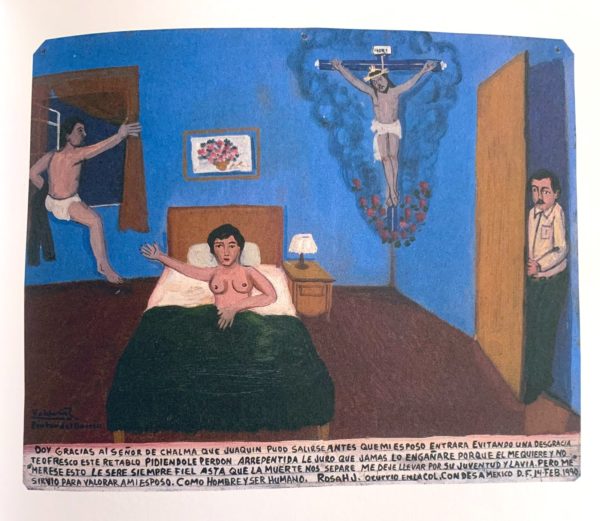
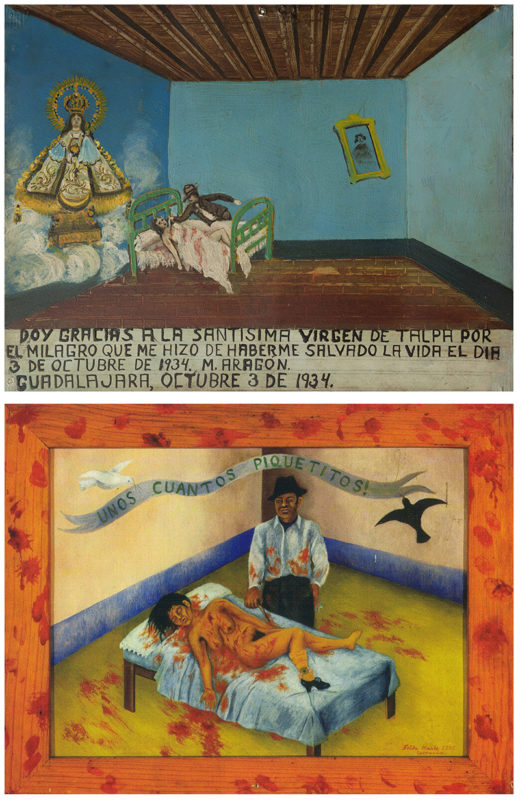
You can see why a cartoonist might be inspired by this form of pictures and words. Your typical ex-voto has a scene of a “near miss” or a miracle, with a saint or religious figure looking over the scene, and words underneath giving thanks. This caption reads:
I give thanks to Lord Jesus of Chalma that Joaquin was able to get away before my husband came in, avoiding a disaster. I offer Him this retablo, begging His forgiveness. I swear in remorse never to cheat [again], because my husband loves me and doesn’t deserve it. I will always be faithful to him till death do us part. I let myself get carried away by [Joaquín’s] youth and smooth talk, but this has made me appreciate my husband, as a man and a human being. Rosa H. J. This took place in Col. Condesa, Mexico D.F. February 14, 1990.
In the book Alfredo Vilchis Roque cites Frida Kahlo as one of his biggest influences, which makes sense because Kahlo and her husband Diego Rivera were avid collectors of ex-votos, decorating their house in Mexico City with hundreds of them. Here is an image I found of part of their collection:
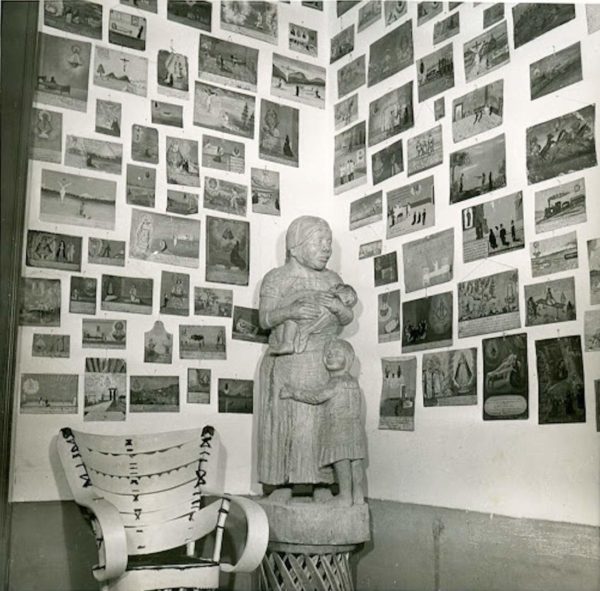
You can really zoom in and get a look at some of these paintings in this photo.
It’s fun to trace the influence of ex-voto on Kahlo’s work in particular, and put some of her paintings next to ex-votos being made at the same time:
* * *
For more reading: “The Vivid Violence and Divine Healing of Ex-Voto Paintings”
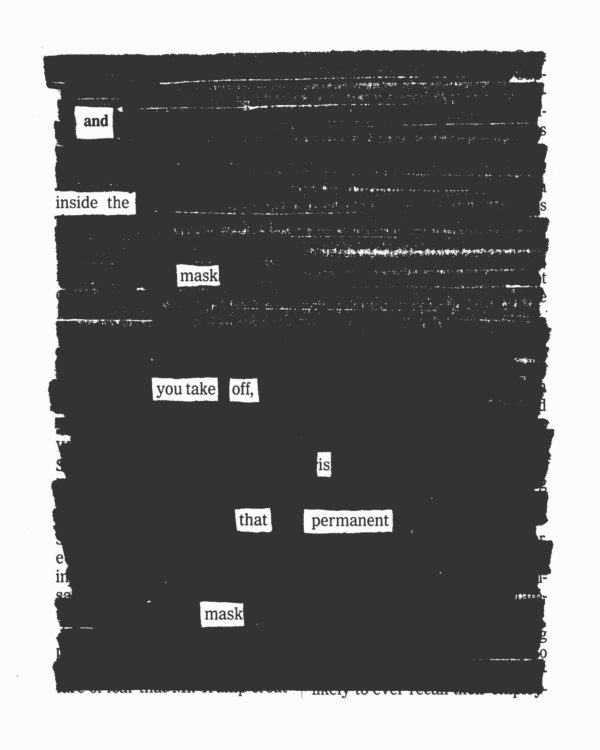
“Man is least himself when he talks in his own person. Give him a mask, and he will tell you the truth.”
—Oscar Wilde“It’s Halloween… I’ve got my Bob Dylan mask on.”
—Bob Dylan, 10/31/1964
Our second pandemic Halloween is coming up, so I’m thinking about masks. Specifically, how much I love photo projects that involve people wearing masks.
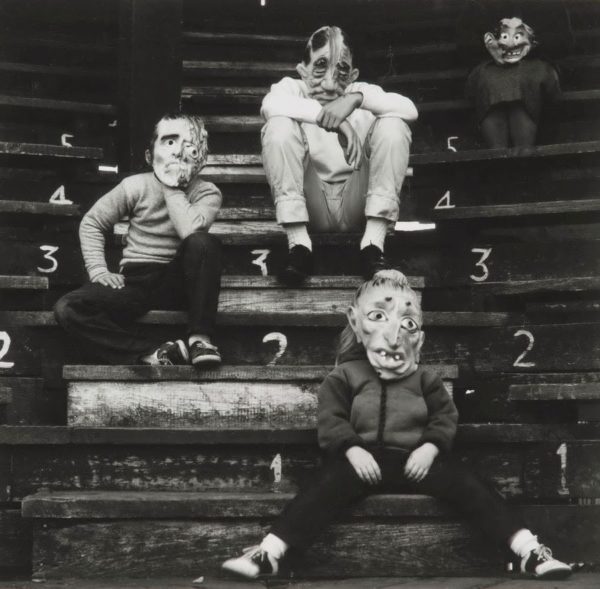
I’ve recently become interested in the photographs of Ralph Eugene Meatyard. In the late 50s in Kentucky, Meatyard, an optician who called himself a “dedicated amateur,” found a bunch of masks in a Woolworths and “over the next 13 years, Meatyard persuaded a procession of family and friends to don one of the Woolworths masks and pose in front of his camera.”
[Photographer Emett] Gowin, who posed for a Meatyard portrait, recalls thinking that wearing a mask would surely erase all sense of personhood. “But when I saw the pictures,” he says, “I realized that even though you have the mask, your body language completely gives you away. It’s as if you’re completely naked, completely revealed.”
Meatyard, btw, wasn’t some lone outsider — he was a part of Lexington’s artistic and literary scene. (Here’s a nice essay that points out the connection between Meatyard’s work and Ambrose Bierce’s The Devil’s Dictionary.)
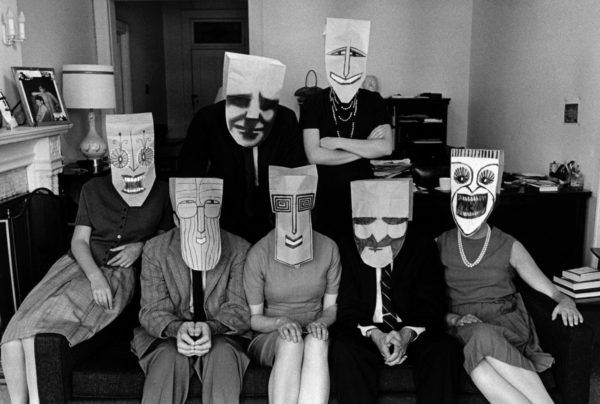
One of my favorite little art books is photographer Inge Morath’s Saul Steinberg Masquerade, a collection of portraits from the turn of the 50s/60s of people wearing Steinberg’s paper-bag masks.
These pictures remind me of something Vlad Nabokov wrote in Strong Opinions:
I don’t think that an artist should bother about his audience. His best audience is the person he sees in his shaving mirror every morning. I think that the audience an artist imagines, when he imagines that kind of a thing, is a room filled with people wearing his own mask.
More from Morath’s book here.
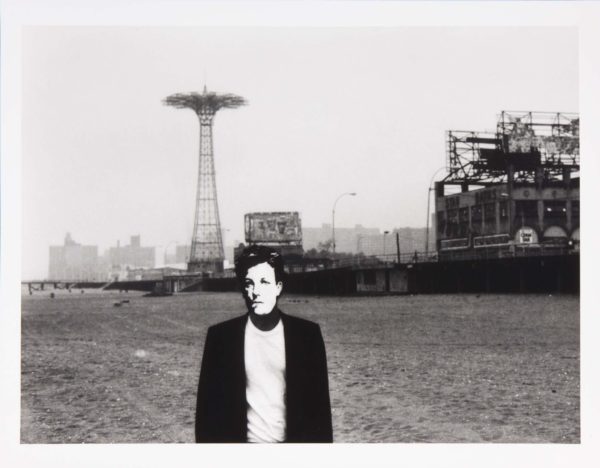
Another series worth mentioning is David Wojnarowicz’s Arthur Rimbaud in New York, photographs he shot in the late seventies of people standing in various NYC places wearing a mask of the poet Arthur Rimbaud.
“What is it about masks and loneliness?” Olivia Laing asks in the Wojnarowicz section of The Lonely City.
The Rimbaud images are often mistaken for self-portraits, but in fact Wojnarowicz stayed behind the camera, using multiple friends and lovers to play the part of the mask-wearer. Nonetheless, the work is deeply personal, albeit in a complicated way. The figure of Rimbaud served as a kind of stand-in or proxy for the artist, inserted into places that mattered to David, places where he’d been or which still exerted a power over him.
If you include the fact that Steinberg called himself a “writer who draws,” all these mask photos have literary links.
And there’s one more link I can think of: the word “hypocrite.”
The word hypocrite ultimately came into English from the Greek word hypokrites, which means “an actor” or “a stage player.” The Greek word itself is a compound noun: it’s made up of two Greek words that literally translate as “an interpreter from underneath.” That bizarre compound makes more sense when you know that the actors in ancient Greek theater wore large masks to mark which character they were playing, and so they interpreted the story from underneath their masks.
Only later did the word come to mean “any person who was wearing a figurative mask and pretending to be someone or something they were not.”
(Another word to look up: Maskenfreiheit.)
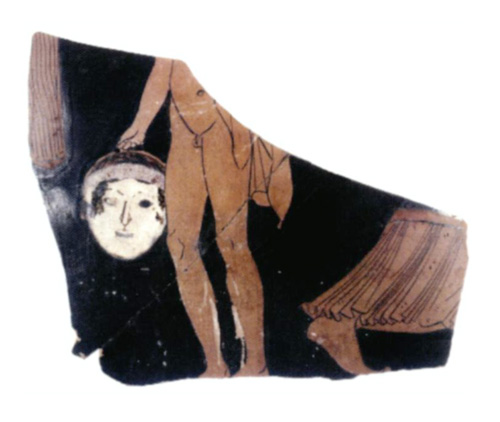
The mouth holes of these Ancient Greek masks were engineered to help the audience hear the actors’ voices. (The mask helped amplify and project what was underneath.) But interestingly, some people like classicist Peter Meineck think it was the ambiguous emotional nature of these masks that made them so effective for drama:
The magic of the mask lies in how it transmutes depending on the angle and context in which we see it. Tilting a mask up and down can change its expression from enraged to content, while a human face is far more consistent from all angles. Because there is no face to tell you explicitly the emotion the character is feeling, your brain takes cues from movement and assigns the face an expression that makes sense. “Your cognitive system is seeing and suggesting the mask moving,” Meineck says.
The mask is a hypnotic call to theatre precisely because each audience member helps to create the emotional drama unfolding on stage. “I believe the mask is far more expressive than the human face,” Meineck says. Rather than being told what to see by an actor’s face, the audience plays a role in creating the emotion, projecting onto the mask what should be there rather than what is explicitly present, similar to the way the brain works to find meaning in abstract art.
(See: “The Neuroscience of the Tragic Mask”)
— Austin Kleon (@austinkleon) October 26, 2021
If you have other mask photography series you think I should see, reply to this thread!
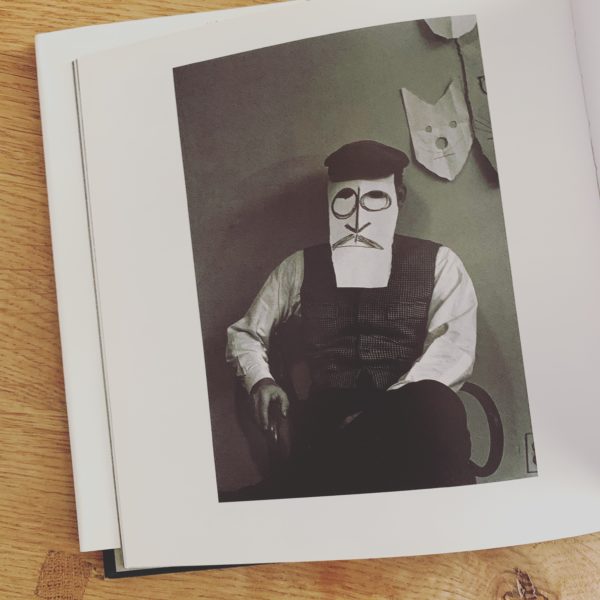
From John Updike’s Self-Consciousness: Memoirs:
Celebrity, even the modest sort that comes to writers, is an unhelpful exercise in self-consciousness. Celebrity is a mask that eats into the face. As soon as one is aware of being ‘somebody,’ to be watched and listened to with extra interest, input ceases, and the performer goes blind and deaf in his over animation. One can either see or be seen. Most of the best fiction is written out of early impressions, taken in before the writer became conscious of himself as a writer. The best seeing is done by the hunted and the hunter, the vulnerable and the hungry; the ‘successful’ writer acquires a film over his eyes. His eyes get fat. Self-importance is a thickened, occluding form of self-consciousness. The binge, the fling, the trip — all attempt to shake the film and get back under the dining room table, with a child’s beautifully clear eyes.
(via @claytoncubitt)
This site participates in the Amazon Affiliates program, the proceeds of which keep it free for anyone to read.
