BLOG ARCHIVES

Posts Tagged ‘workspace’

THE POWER OF MYTH AND JOSEPH CAMPBELL ON ART-MAKING

Thursday, May 15th, 2008

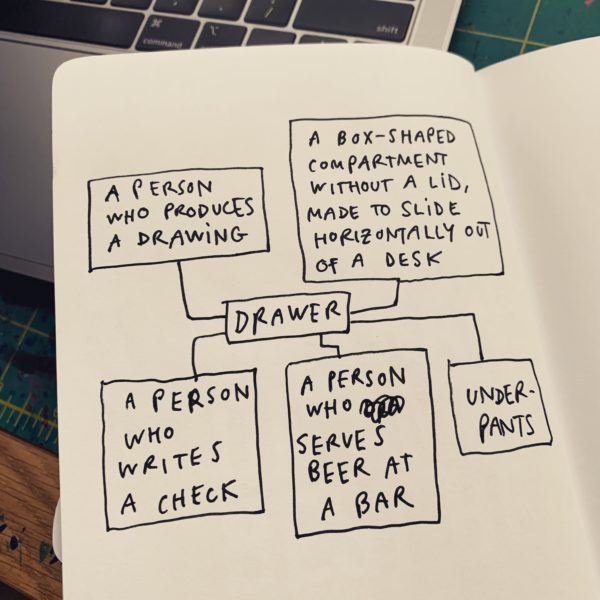
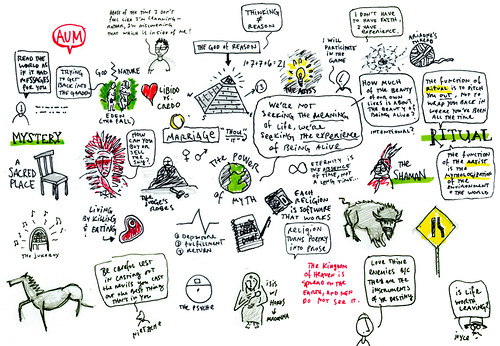
MINDMAP OF JOSEPH CAMPBELL'S THE POWER OF MYTH

Do ever feel like when you’re reading, you aren’t really learning anything, but you’re re-discovering what you already had inside you? That’s how it felt after reading The Power of Myth, a book companion to the PBS mini-series featuring Bill Moyers and mythologist Joseph Campbell in conversation. Having never read any Campbell (I’m starting on The Hero With A Thousand Faces next) I found it to be a great introduction to his worldview.

Campbell had a lot of wisdom for artists, but here are two of the more practical excerpts.

On having a “sacred place”:

[A sacred place] is an absolute necessity for anybody today. You must have a room, or a certain hour or so a day, where you don’t know what was in the newspapers that morning, you don’t know who your friends are, you don’t know what you owe anybody, you don’t know what anybody owes to you. This is a place where you can simply experience and bring forth what you are and what you might be. This is the place of creative incubation. At first you may find that nothing happens there. But if you have a sacred place and use it, something eventually will happen….

[O]ur life has become so economic and practical in its orientation that, as you get older, the claims of the moment upon you are so great, you hardly know where the hell you are, or what it is you intended. You are always doing something that is required of you. Where is your bliss station? You have to try to find it. Get a phonograph and put on the music that you really love, even if it’s corny music that nobody else respects.

On how to read:

Sit in a room and read—and read and read. And read the right books by the right people….When you find an author who really grabs you, read everything he has done. Don’t say, “Oh, I want to know what So-andso did”—and don’t bother at all with the best-seller list. Just read what this one author has to give you. And then you can go read what he had read. And the world opens up in a way that is consistent with a certain point of view. But when you go from one author to another, you may be able to tell us the date when each wrote such and such a poem—but he hasn’t said anything to you.

(This is something that both my friend Brandon and George Saunders have suggested.)

Great book. Highly recommended. Here are some other excerpts.

the power of myth

EXPATRIATE

Thursday, May 1st, 2008

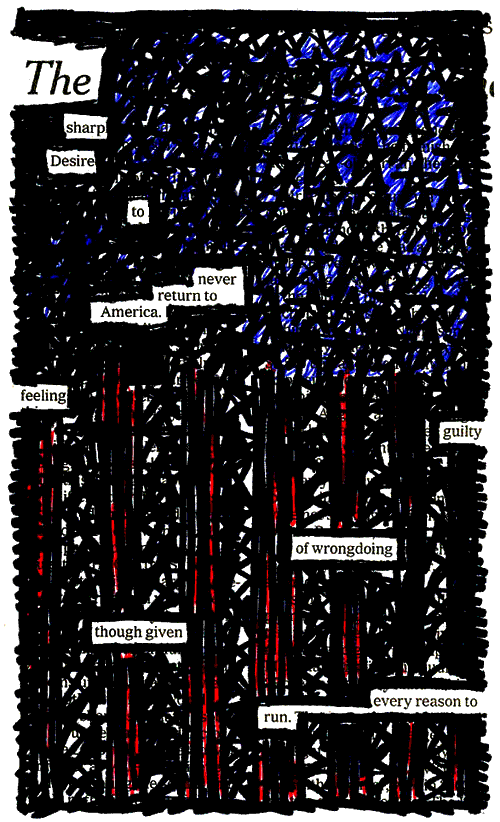
EXPATRIATE

An arming scene of sorts:

05-01-08_1334

Cutting strips of New York Times at lunch. (Thanks to Adam for the donation!)

Become a fan of the poems on Facebook

UNLIMITED NEWSPRINT AND A VIEW

Monday, July 2nd, 2007

Our lease was up in July, so Meg and I moved into her parents’ house to save a month’s rent for our upcoming move. We’re leaving a ton of our furniture in Cleveland, and we’ve outfitted Meg’s old room as a guest suite. As a result, I have one of the nicest workspaces ever — my blue desk now looks out onto the lovely woods, with the birds chirping.

They also have an NYTimes subscription, so you might see more blackout poems as the month progresses.

SKULKING AROUND BARNES AND NOBLE

Thursday, October 26th, 2006

cover.jpg

I really need to get an office.

Right now, our living room doubles as my workspace, and that’s bad, because when I step into the room in the morning, I don’t know whether to write, or take a nap on the couch.

It’s better today, because the radio’s on, and there’s actually SUNLIGHT coming in the front window.

Yesterday I got so stir-crazy I went to Barnes and Noble with my sketchbook to work. I ended up doing little work, and a lot of reading.

I spent the majority of the time reading Ivan Brunetti’s fantastic new anthology, GRAPHIC FICTION, CARTOONS, & TRUE STORIES. (Here is the table of contents.) If you’re a newcomer to comics, this is probably the new place to start. It’s pretty amazing. I especially like the 20-page section dedicated to Peanuts, which included Art Spiegelman’s New Yorker tribute piece, “Abstract Thought Is A Warm Puppy” and an essay by Schulz himself, “Developing A Comic Strip,” which Brunetti uses in all his classes. (WMFU had an interview with him about the book a few days ago, and here’s another with Mr. Skin.)

Yale University Press has a really outstanding line of comics-related books on the market right now. In The Studio: Visits With Contemporary Cartoonists is probably the most unique: it features monologues and skethbook work by folks like Crumb, Panter, and Brunetti, but it also includes personal artifacts from each cartoonists’ stash: old magazines and comics, toys, posters, etc. The best part is Crumb talking about his current project: he’s illustrating every story from Genesis, using three different translations, and “telling it straight.” I can’t wait to see this. It’s going to be 180 pages long, and supposedly, he’s 60 or so pages into it.

But the winner yesterday was the new “graphic” issue of TIN HOUSE. It has a ten page or so excerpt from Lynda Barry’s WHAT IT IS, a new collage/book/thingie about images in progress, and an interview with her, too, not to mention stuff from Stuart Dybek, Marjane Satrapi, and a childhood comic by Dan Chaon.

I love the fact that Lynda sells her stuff over Ebay. Even her “throwaway” sketchbook pages blow my mind:

08_3.jpg

f8_3.jpg

Here’s a student summary of one of her workshops about “the image” and writing.

THERE IS NO ONE THING, ONLY A DOZEN SURFACES

Wednesday, March 1st, 2006

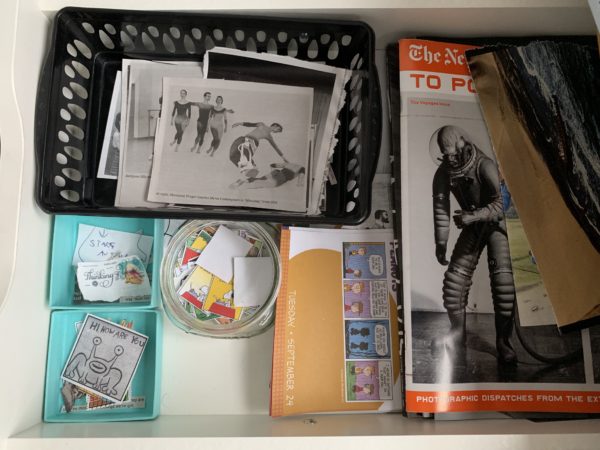
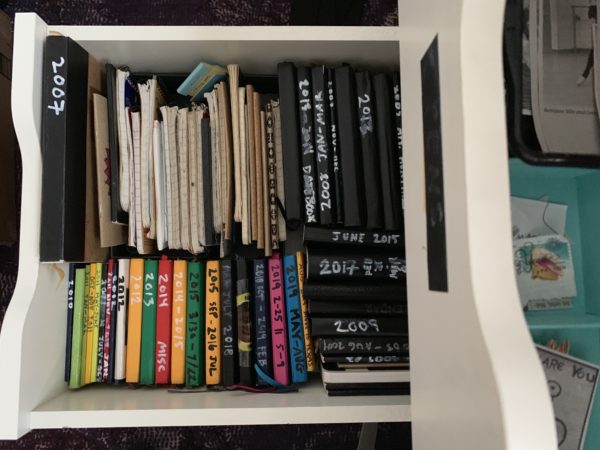
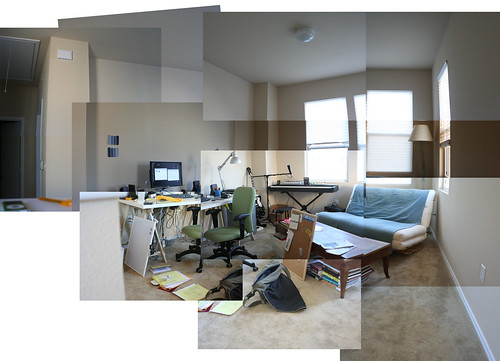
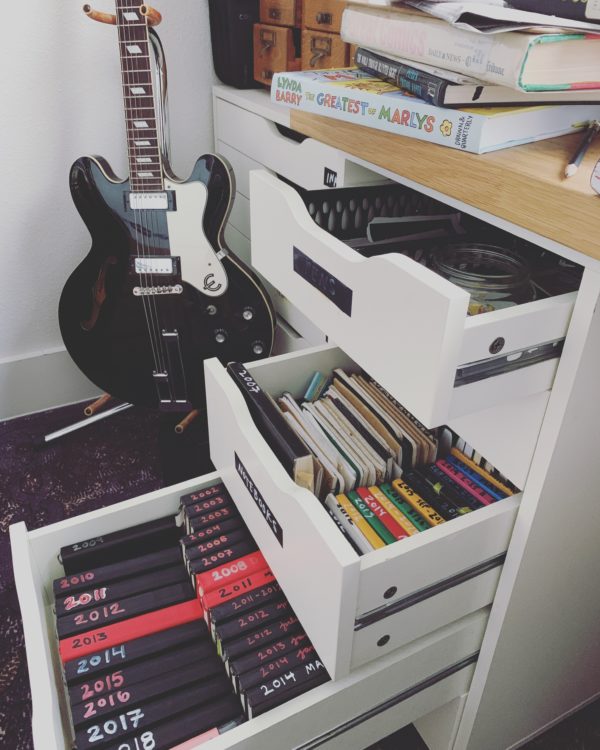
workspace.jpg

Thinking lately about workspaces, about how working with the computer affords the sketchbook greater authority, because tiny scribbles can be scanned and blown up to gigantic proportions, mistakes can be erased, materials of all shapes and kinds and sizes can be formed into one thing–one computer file…and how, there is no original, only a digital collage.

Along the same lines, here’s Jonathan Safran Foer describing Art Spiegelman’s studio in his essay “Breakdownable,” from the great read, MASTERS OF AMERICAN COMICS:

“At the center of the office was an enviable Captain Kirk-like raised computer station: a pretty serious screen, two scanners, a pad on which to draw straight onto the computer, a side area for sketching, bottles of inks, a can of writing implements, shelves of cds, a stereo console, and various unidentifiable miscellany…

“Beside this setup was a very cool light table, on which rested a drawing-in-progress. Across from that, against the window, was an old-fashioned drafting table. If memory serves, there was a scratched-up desk across from that. There must have been half a dozen desks thoughout the office. How could one person, I wondered, need so many surfaces? Where is the army of Art Spiegelmans?

“We talked about the originals of his drawings. I wanted to use the excuse of this short essay to see them. Art explained that given the way he works, moving freely between paper and the computer, pen, pencil, and ink, no such things exist. There are sketches. And there are drawings done directly on the computer. And there are more fleshed-out drawings. And there are altered, cobbled-together images on the computer. But if one’s dream were to hang In the Shadow of No Towers, from beginning to end, one would be disappointed.”