BLOG ARCHIVES

Posts Tagged ‘WORLDBUILDING’

MAPS OF FICTIONAL WORLDS

Wednesday, May 21st, 2008

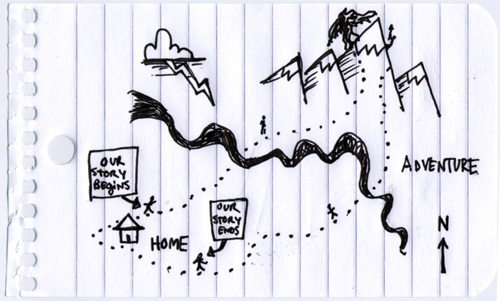
map of the story

“When I first decided I wanted to be a writer, when I was 10, 11 years old, the books that I loved…came with maps and glossaries and timelines—books like Lord Of The Rings, Dune, The Chronicles Of Narnia. I imagined that’s what being a writer was: You invented a world, and you did it in a very detailed way, and you told stories that were set in that world.”—Michael Chabon, Interview with the AV Club

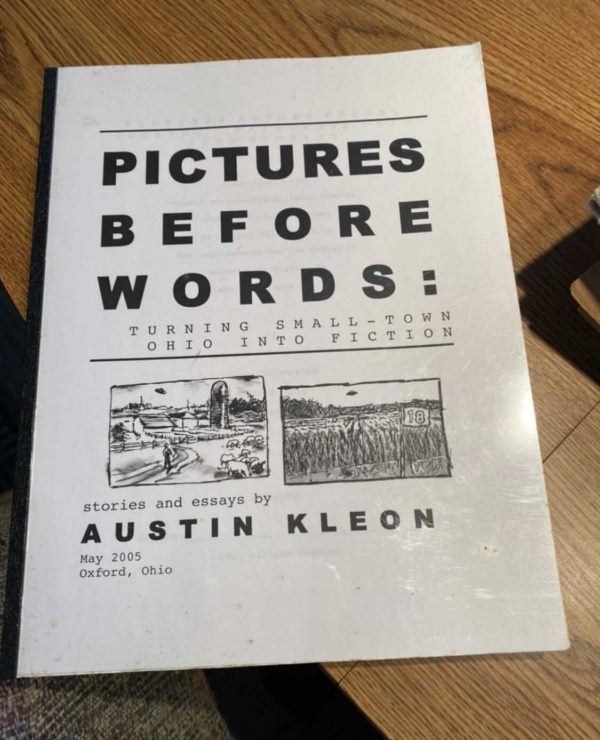
My undergrad thesis argued that world-building wasn’t just for fantasy and sci-fi writers—every tale has a setting, every tale creates a world in the reader’s mind—and it explored ways that drawing that world (visual thinking!) can lead to better fiction.

Some of my favorite “lit’ry” books are accompanied by maps.

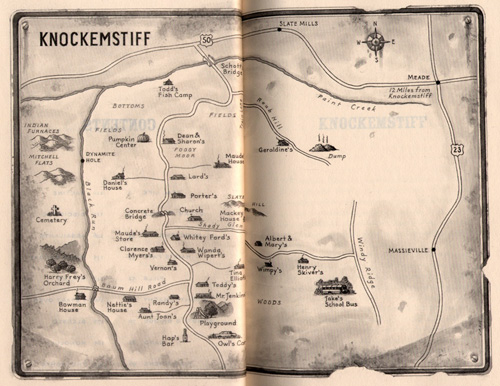
A recent read, Donald Ray Pollock’s short-story collection, Knockemstiff, is set in the “real” town of Knockemstiff, right outside of Chillicothe, Ohio (30 miles from where I grew up—if you keep heading north on 23 you’ll get to Circleville). The book includes a nice hand-pencilled map by artist David Cain:

map from donald ray pollock's KOCKEMSTILL

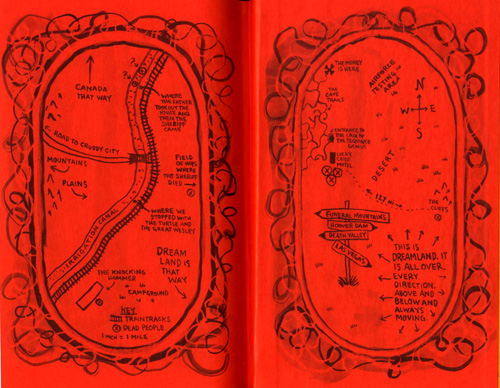
Lynda Barry’s Cruddy contains four maps. Here’s two of them:

map from lynda barry's CRUDDY

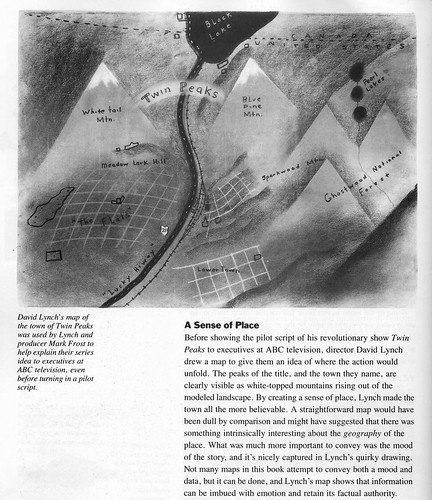
And while it was a TV show and not a book, one of my favorite fictional worlds, Twin Peaks, was drawn by David Lynch for the pitch meeting:

MAP OF TWIN PEAKS BY DAVID LYNCH

Some writers use previously-made maps to help create their fiction: Melville used whaling charts, Joyce used Ordnance surveys of Dublin, and Pynchon used aerial maps.

Poking around the ‘net I found maps for Faulkner’s books, Treasure Island, and of course, Tolkien.

What other favorite books of yours include maps? Let’s get a big ol’ list going in the comments!

CHABON ON WORLDBUILDING

Friday, July 6th, 2007

“When I first decided I wanted to be a writer, when I was 10, 11 years old, the books that I loved…came with maps and glossaries and timelines—books like Lord Of The Rings, Dune, The Chronicles Of Narnia. I imagined that’s what being a writer was: You invented a world, and you did it in a very detailed way, and you told stories that were set in that world.”

- Michael Chabon, Interview with the AV Club

Believe it or not, I’ve never read anything by Michael Chabon, save for his great introduction to the McSweeney’s Thrilling Tales collection. (This seems particularly pathetic because Wonder Boys happens to be one of my favorite movies.) But, at the beach this year I’m gonna to read The Amazing Adventures of Kavalier and Clay, and Meg’s gonna read The Yiddish Policemen’s Union.

SOME THOUGHTS ON FUN HOME

Wednesday, July 26th, 2006

Last night I finished Alison Bechdel’s excellent comics memoir, FUN HOME. I don’t have a whole lot to add to the raves (it’s been on on NPR, it’s gotten fabulous reviews, it’s selling like hotcakes all over), but it probably ranks up there with some of the best graphic novels I’ve ever read.

While it’s a genuinely enjoyable read, with a subject matter as engrossing and complex as any prose memoir, the carnivorous, thieving cartoonist in me solidified some of my feelings about the form, and found some good things to steal…

Disclaimer: Gerry over at Backwards City recently linked to this Wired article about academics at Comic-Con, so more than usual, I’m fully aware that writing about comics is pretty lame. “You have this dog and you love it, and you want to find out why you love it. You dissect it, and you’re left with this dead bloody dog on the table. That’s one of the things that academics do.” But I’m going to do it anyways, and haphazardly at that.

JUXTAPOSITION OF VOICEOVER NARRATION AND IMAGE/DIALOGUE

For me, the greatest technical accomplishment in FUN HOME is the juxtaposition of Bechdel’s written, first-person narrative with her panels and speech bubble dialogue. This might be a “duh” observation, as word/picture juxtapostion is something you might take for granted as a pre-requisite for comics, but that’s simply not the case. Take something like Brian K. Vaughn’s equally excellent Y: THE LAST MAN, for instance: it plays out like a really intricate movie: there is no narrator, only a camera’s eye. The same for most gag strips, like PEANUTS and KRAZY KAT: there is no narrator, only the characters and speech bubbles.

What voiceover narration (for lack of a better term) allows you to do in comics is make bigger jumps in between moments in time and images, thereby freeing you from the kind of static, talking head syndrome of plays or scenes in film. It also, through juxtaposition, allows you to cram a bunch of information into a tiny amount of space. My favorite folks who use the technique (and consequently, my favorite cartoonists) are Lynda Barry and James Kochalka. What it really is, I think, is the perfect integration of writing and art.**

Anyways, in creative writing classes, they’re always harping at you to show, not tell.*** Use concrete language verses abstract language. If you notice, much of the voiceover narration is ridiculously abstract, but combined with the concrete images and dialogue of the panels, you get this sweeping, novelistic effect…a soothing voice that takes your reader by the hand and leads them through the world, reflects on what is happening. Less voyeuristic, I guess, and more like a tour…

RECURSIVE NARRATIVE, ARCHIVAL ELEMENTS, AND THE UNITY OF STYLE

As Hillary Chute in her Village Voice review pointed out, “Fun Home ’s narrative is recursive, not chronological—it returns again and again to central, traumatic events.” This is something that I think begs to be looked at in terms of world-building. FUN HOME isn’t so much a chronological retelling of events as much as it is a world.

Dylan Horrocks, once again:

…the panel is a unit not of time or space, but of meaning (a kind of sememe). And rather than being arranged in a sequence, Kochalka’s units are arranged in rhythmic patterns. The purpose of these patterns, he claims, isn’t merely to depict the flow of time, but to “create and activate a world inside us.”

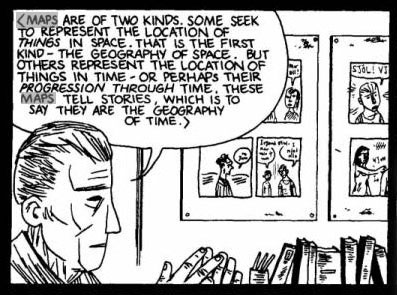
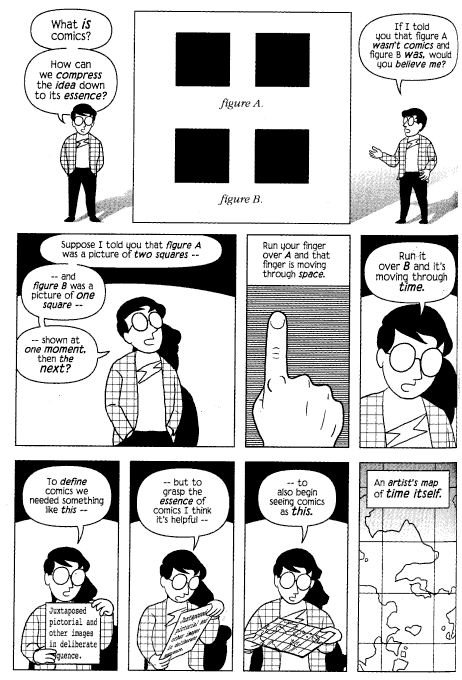
Now, most discussion about comics (or fiction, for that matter) assumes that their main purpose is to tell a story – a narrative that moves through time; hence McCloud’s description of comics as a “temporal map.” But here, Kochalka seems to suggest something quite different: that comics create a world, a place. Instead of SPACE = TIME, this is SPACE = SPACE.

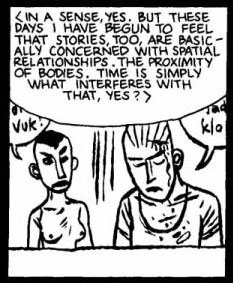
Bechdel returns again and again to maps and explaining events in geographical terms, and FUN HOME is like a map of Bechdel’s brain, and her archive: it contains “handwritten letters from [her] father, typewritten letters from both her parents, her father’s police record, dictionary entries, her own childhood and adolescent diaries, and many maps. Bechdel re-drew—re-created—everything in her own hand.”

That Bechdel chose to re-draw all these elements in her own hand is a trick to graphic novel writing: the style unifies the disparate elements, so you can turn to any page, and it looks like it comes from the same world, filtered from the same mind.

Okay, that was kind of a pantload. I promise tomorrow I’ll just post a pretty picture and call it a day.

**Dylan Horrocks recently said on his blog: “[Comics] allow you to be both an artist and a writer all at once. And many (James Kochalka is one example who comes to mind) seem to me to defy any attempt to place them in either of two such arbitrary ‘camps.’

***which makes me wonder, really, if there’s any hope for applying the MFA workshop format to making comics. Check out this great interview with Francine Prose about the sorry state of MFA programs.

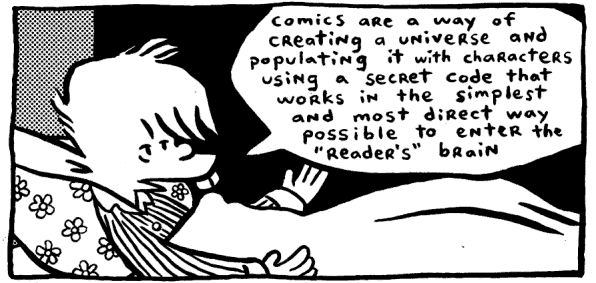
IT’S JUST A SERIES OF GAG STRIPS WRITTEN IN A SECRET CODE

Saturday, June 24th, 2006
“To construct a picture-story does not mean you must set yourself up as a master craftsman, to draw out every potential from your material —often down to the dregs! It does not mean you just devise caricatures with a pencil naturally frivolous. Nor is it simply to dramatize a proverb or illustrate a pun. You must actually invent some kind of play, where the parts are arranged by plan and form a satisfactory whole. You do not merely pen a joke or put a refrain in couplets. You make a book: good or bad, sober or silly, crazy or sound in sense.”

—Rudolph Töpffer, Essay on Physiognomy, 1845

* * *

Anything new: you wonder what to call it. I’m calling mine a graphic novel for the marketers. But what it really is is a Cartoon Novel. Or a novel-in-cartoons. Or just a book.

Kurt Vonnegut said he wrote Cat’s Cradle as if each chapter were a joke. Nathaniel West said he originally pictured Miss Lonelyhearts as a novel in comic strips.

I’m trying to write mine as if each page is a gag strip. Only the gags build into a story. And lots of them aren’t funny at all.

Peter Orner’s excellent new book is kind of like that. Each part is a little episode. And the episodes build into something big.

Whatever it is, it’s a book. This, I think, is a revelation.

* * *

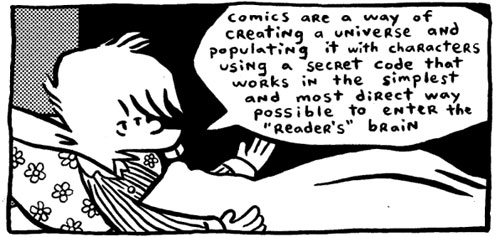
htpg13.GIF
- James Kochalka, quoted in Dylan Horrocks’ “The Perfect Planet: Comics, Games, and World-Building.”

* * *

George Saunders says that as a young boy, he felt the language in Esther Forbes’ Johnny Tremain was a code he could break, “a code that turned out to be more accurate and expressive than the one we all use to slog through normal life.” And breaking this code suggested to him that he might be able to come up with his own code, “a premonition that my complicated feelings about life could be subjugated to that quest, which has turned out to be true.”

People talk about voice and style, and I have no clue what they’re talking about. “Find your voice!” they say.

Screw that. I’m working on my secret code.

LYNDA BARRY AT OBERLIN

Tuesday, April 18th, 2006

LYNDA BARRY READING AT OBERLIN

“You two are GETTING MARRIED??? Oh man, I LOVE being married!!!”

Long story short, we took a detour on our way back home last night and ended up at a bar with Lynda Barry, Dan, and a bunch of other nice Oberlin folks, talking about marriage, writing, world-building, video games, ink sticks, George Saunders, smoking, and Skoal rings.

Lynda gave a downright marvelous talk and reading of her novel CRUDDY to a packed lecture hall at the Oberlin Science Center. “I feel like this must be the Make A Wish Foundation,” she said, admiring the audience. “I have a tumor right?”

Lynda lives in rural, southern Wisconsin. “I’m the daughter of a meat cutter and a Filipino house cleaner. Most people look at me funny when I say I’m half Filipino, but Norwegian blood will suck the color out of anything.”

There was little talk of comics, and a lot of talk about writing. For her, telling a story in images is the most important thing. “When you’re in that image state, the language takes care of itself.” She outlined a process of telling the story of your life with an image–a car, for example–focusing on that image, and then describing the world around it. I mentioned to her my ideas about worldbuilding and she said, “People ask me if my stories are autobiographical. I say, ‘my stories aren’t, but my settings are.’”

She talked about “the state of play,” and the importance of play in our creative endeavors. “I love kids, man. They can teach us so much.” She said its essential to recapture that youthful, unfettered creativity that we all possess as children. On English class: “There’s nothing wrong with taking apart stories, but for the longest time I thought that was how you put them together.” On that pesky editing monkey on the writer’s shoulder: “When did the asshole become the voice of reason?”

She’s wary of computers and a champion of drawing and writing by hand. “In the digital age…don’t lose your digits!” She said when writing her second novel, the computer was a burden, making it too easy to delete things. After ten years of working on it, she decided to start writing the novel with her Japanese brush, and it worked like magic.

Later on, I told her I worked on the computer to do my woodcut-styled comics. “Yeah, but you use a Wacom tablet,” she said, “so at least you’re still drawing.”

I mentioned to her that James Kochalka, another great cartoonist, also emphasizes the importance of play, but that his emphasis comes from his love of video games. “I don’t know about video games, man. But I trust young people. That many young people can’t be wrong.”

What else can I tell you about the woman? She spent an hour signing books and talking with her fans. She likes to sing. She can even sing with her mouth closed.

She’s one helluva gal.

WORLDBUILDING WITH TIM SCHAFER

Saturday, February 4th, 2006

Over at Gamestudies.org, there’s a fantastic 2003 interview with Tim Schafer, creator of some of my all-time favorite LucasArts adventure games. Schafer studied computer programming at UC Berkeley, got bored with computer programming and thought about becoming a writer, then landed a job with LucasArts right out of college. He worked on Day of the Tentacle, Full Throttle, and Grim Fandango, and then opened up his new production company, Double Fine Productions, which last year put out the game, The Psychonauts, which, though it didn’t sell well, ended up on tons of top-10 lists.

In the interview, Schafer talks about worlds being the initial inspiration for his games, and characters being the motivational force to keep players playing. “The goal,” he says, “is really to create this total immersive fantasy experience, where you’re sucked into a strange world, where you are the character, and you’re having all this fun, and you get to do anything you want.”

CP: I’m curious when you’re starting a new game and inventing a new world, what’s your process? How do you go about creating a world?

TS: Well, often, the world is the initial inspiration for the game. One day I was listening to someone tell me their stories of spending the summer in Alaska. They had hung around this one biker bar, with these people with names like Smilin’ Rick and Big Phil. And I thought, “Wow, what a crazy world that is.” It’s so apart from everybody’s life, and yet it’s right there, it’s so mundane in a way. And that’s where Full Throttle came from. The world was the starting point. And Grim Fandango, also, seeing the Day of the Dead art, that was the starting point too. So it wasn’t so a game idea, and then “let’s make a world to fit it.” You sort of stumble upon some world, and thing - that’s something that’s never been brought to life before. Let’s bring it to life. Wouldn’t it be fun to run around in that world?

I found all his thoughts about making games to be easily transferrable to the crafting of fiction or comics. Eventually, I want to teach the old LucasArts adventure games right beside novels and comics in creative writing classes. Problem is, it’s hard to get some of them to work on new computers (I never have been able to get Grim Fandango to work). Some clever fellows have created engines to help out: check out SCUMMVM and QUICK AND EASY.

UPDATE (3 days later): Since some Studio 360 intern reads my blog and steals my ideas, here’s Kurt Anderson interviewing Schafer about the Psychonauts.