Jessica Abel and Matt Madden were in town this weekend to promote Jessica’s La Perdida and Life Sucks, and their brand-new comics textbook collaboration, Drawing Words and Writing Pictures (great title). Yesterday they talked about the books (in that order) at Austin Books and Comics. There was a small crowd, not much A/C, and a keg of beer!
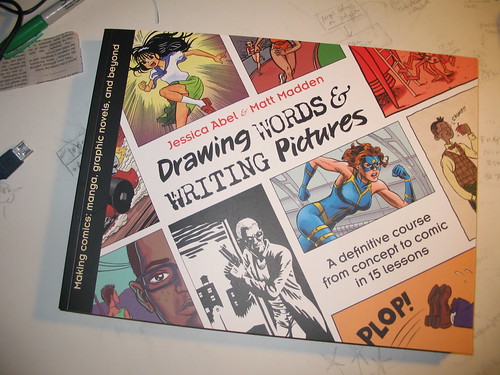
The biggest treat was that we got to buy a copy of the new textbook, which doesn’t officially come out for a week or so:
Some things I took away from their talk:
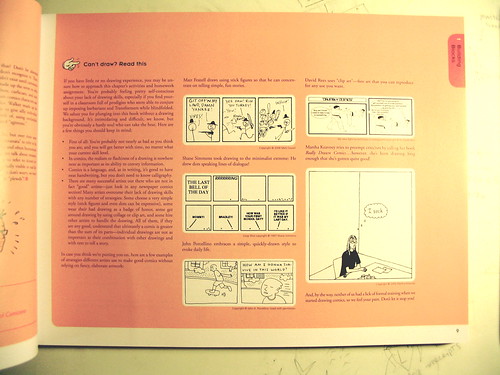
- Jessica’s early stuff was drawn with a pen very realistically, with tons of detail, so for La Perdida, she went for a sketchy, brush drawn look, which she thought turned out to be more realistic, because readers could fill in the world around the significant, selected details. This came out as sort of an off-the-cuff remark, but as Meg pointed out to me, it’s one of the most important lessons of comics: less is sometimes more, and since every comic drawing is a visual metaphor, there’s a balancing act when it comes to the level of abstraction in your drawings (see McCloud).
After she said that, when I was flipping through the book I found this cool example:
- Meg mentioned how much the technical skills (pencilling, layout, inking) of comics resemble architecture. That got me thinking: someone who wanted to study comics in a traditional academic setting would likely first think to seek out say, life-drawing and creative writing classes, which are fine, but they might be better served by design (typography, page layout, the grid), screenwriting (dialogue, visual storytelling), or poetry (economy of words, laying them out in space).
- Their book is aimed at three different types of comics creators:
- Students in the classroom
- Ronin — lone warriors out on their own
- Nomads — small groups (i.e. a writing group that meets once a week at a coffee shop)
The book is formatted so that each type of creator can benefit from the lessons.
- Men seem to like the idea of having a separate studio space away from the house, while women seem to prefer a room at home. (At least it’s the same for Meg and me. Discuss.)
- Matt and Jessica have a new baby, and Meg noted that people always seem to ask “male-oriented” questions at those events—she wanted to ask how you keep a house running and still find time to create (but didn’t…and it would’ve been a great question, too!)
- Comics is a language, people!
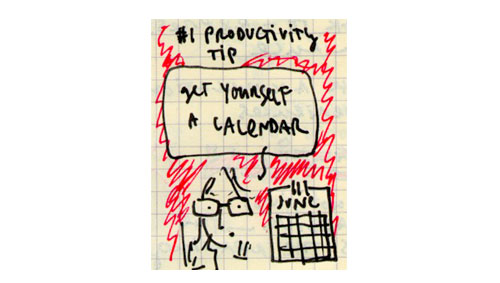
- Jessica’s #1 productivity tip: get a calendar, and stick to it! (More details)
Since both Matt and Jessica are teachers at SVA, I asked them if they saw any pitfalls, teaching comics in the academy. Is there a chance that comics programs could turn out like MFA writing programs, with students turning out uniform, quiet, lit’ry, “workshopped” New Yorker types of short stories?
They both agreed that “it all comes down to the teachers,” and “if comics can’t withstand being taught in the academy, what kind of medium is it?”
I mentioned Lynda Barry’s new book as a great antidote to the “bad” kind of creative writing teaching, and Matt had a great reply:
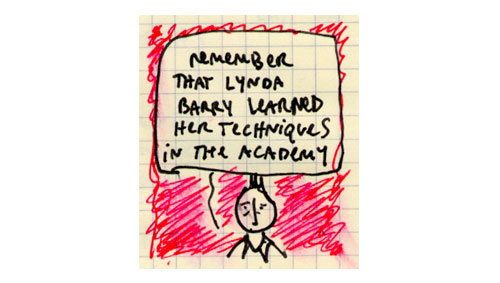
(He was referring to Lynda’s art teacher in college, Marilyn Frasca.)
Overall, I think this book is extremely well done and worth checking out by anyone who’s interested in making comics—it’s probably the first book I’ve ever seen that could actually serve as the lone textbook for a comics-making class. I think it will sell like hotcakes, and, as Jessica and Matt hinted, we’ll definitely see a sequel focusing on “advanced” topics such as coloring and webcomics.
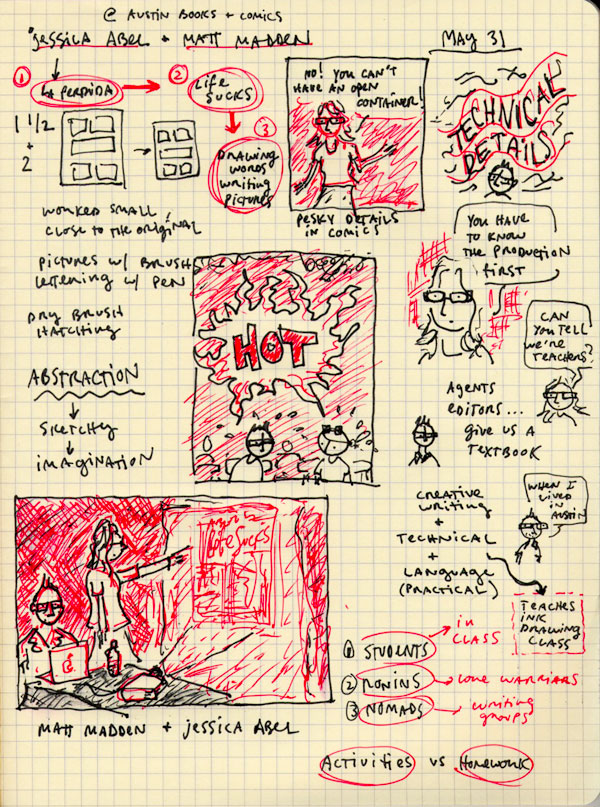
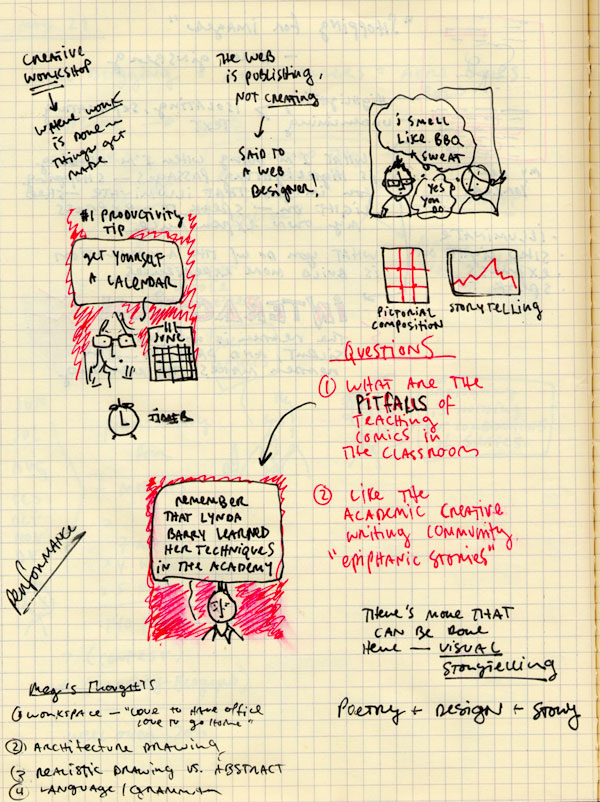
My complete notes from the talk, if anyone’s interested:
Thanks to Matt and Jessica for swinging down to Austin!
Couple of questions:
1. Do you think the book would be suitable for a 10-year-old who wants to make comics?
2. Could you please expand on what Jessica said about sticking to a calendar?
Tim:
1. I will think about that question while reading the rest.
2. She actually did a post over at First Second about keeping a calendar that I completely forgot about:
Read more…
I would love to hear more about how to stick to the calendar. I know that it can be really hard to do, but how do you avoid the day to day pitfalls that seem to suck down the time? Did she talk about time pits like email and phone calls that seem to eat up the day?