I’ve received a few e-mails from young(er) writers in the past couple of months, many of them trying very hard to figure things out and looking for words of advice and encouragement. Because I’m totally unqualified and ill-equipped to deliver them such words, I’m reading The Master: Rainer Maria Rilke and his Letters To A Young Poet.
Rilke was twenty-seven—still a young artist with his best work ahead of him—when he got a letter from a nineteen-year-old military school student named Franz Kappus. Kappus sent Rilke some poems and asked him for advice about becoming a writer. Rilke got lots of letters from aspiring artists, but Kappus’s touched him: Rilke had spent the worst five years of his young life forced by his parents into the same military school. And so o began a ten-letter correspondence lasting from 1902–1908.
The letters aren’t really letters, they’re diaries. Rilke saw himself in Kappus, and so they’re written from Rilke to Rilke—both to his past and his present. They begin with a description of Rilke’s current setting (various cities across Europe) and continue into the subject of how to live and how to create. Each is a map of where he’s been and where he needs to go.
There’s so much to take away from the ten letters, but here’s a short-list of questions a young writer might ask, with Rilke’s responses.
Is my stuff any good? Am I good enough to really make it as writer?
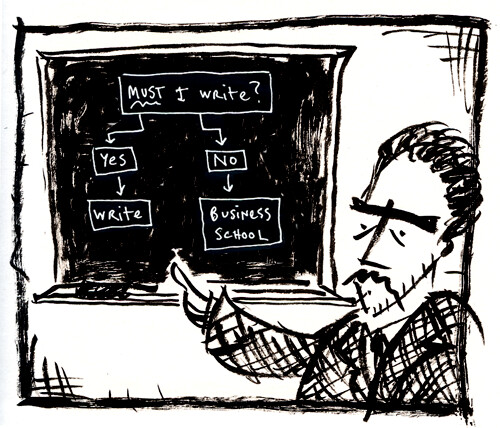
[You’re asking the wrong questions!] There is only one thing you should do. Go into yourself. Find out the reason that commands you to write; see whether it has spread its roots into the very depths of your heart; confess to yourself whether you would have to die if you were forbidden to write. This most of all: ask yourself in the most silent hour of your night: must I write? Dig into yourself for a deep answer. And if this answer rings out in assent, if you meet this solemn question with a strong, simple “I must,” then build your life in accordance with this necessity….
…But after this descent into yourself and into your solitude, perhaps you will have to renounce becoming a poet (if, as I have said, one feels one could live without writing, then one shouldn’t write at all). Nevertheless, even then, this self-searching that I as of you will not have been for nothing. Your life will still find its own paths from there, and that they may be good, rich, and wide is what I wish for you, more than I can say.
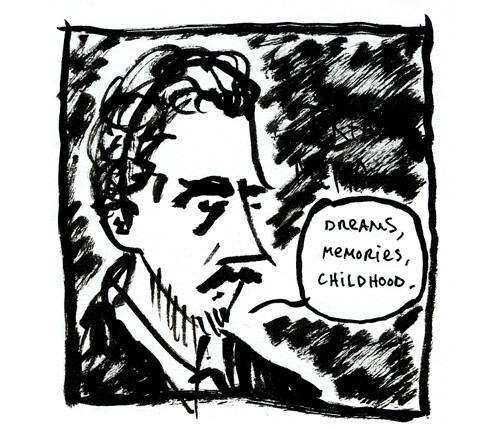
What should I write about?
Write about what your everyday life offers you; describe your sorrows and desires, the thoughts that pass through your mind and your belief in some kind of beauty – describe all these with heartfelt, silent, humble sincerity and, when you express yourself, use the Things around you, the images from your dreams, and the objects that you remember. If your everyday life seems poor, don’t blame it; blame yourself; admit to yourself that you are not enough of a poet to call forth its riches; because for the creator there is not poverty and no poor, indifferent place. And even if you found yourself in some prison, whose walls let in none of the world’s sounds – wouldn’t you still have your childhood, that jewel beyond all price, that treasure house of memories?
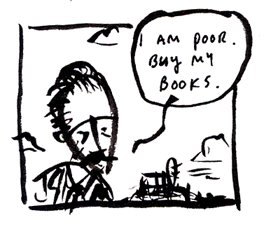
Can you send me some freebies?
…as to my own books, I wish I could send you any of them that might give you pleasure. But I am very poor, and my books, as soon as they are published, no longer belong to me. I can’t even afford them myself – and, as I would so often like to, give them to those who would be kind to them.
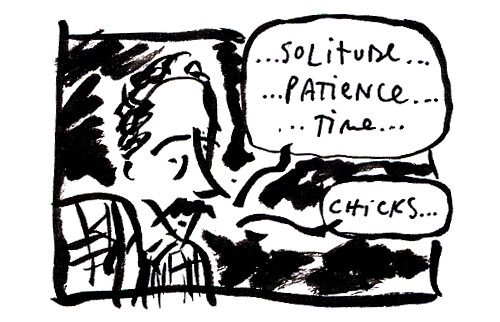
What about chicks?
For one human being to love another human being: that is perhaps the most difficult task that has been entrusted to us, the ultimate task, the final test and proof, the work for which all other work is merely preparation. That is why young people, who are beginners in everything, are not yet capable of love: it is something they must learn.
Okay, I must write—but how am I supposed to feed myself?
[….]
That’s a subject Rilke doesn’t really touch on. For a good 20th century update, I’d point to Hugh MacLeod’s “How To Be Creative.”
If you haven’t yet read Letters To A Young Poet, I highly recommend doing so. Get the the Stephen Mitchell translation.
A very enjoyable post, Austin. I’ve been meaning to read these letters front to back for YEARS and have never gotten around to it. I feel like you’ve given a good introduction to them, and strong encouragement that I finally go and read them. Thanks.
Thanks, David! I forgot to mention, it only takes an hour or so to read them all…
“Write about what your everyday life offers you…”
And thus we get so many works about depressed youths and endless novels about novelists and comics about cartoonists.
That now cliched advice has done a lot of harm, I think.
Thanks for the info. It helps. :)
Derik, thanks for bringing that up. John Gardner said it best in his book, THE ART OF FICTION:
Write what you know. Write what you like.
That’s a great quote, Austin. One area where I agree with Gardner (there are many areas where I don’t. He had a long running argument with William Gass on ideas about fiction and I’m much more on the Gass side).
“The writer writes well about what he knows because he has read primarily fiction of this kind–realistic fiction of the sort we associate with The New Yorker, the Atlantic Monthly, or Harper’s. The writer, in other words, is presenting not so much what he knows about life as what he knows about a particular literary genre.”
I wonder how much relevance we could find to this in autobio comics. How much of it comes from a predecessor in the genre (Crumb, Porcellino, Chester Brown).
Here’s some great advice for young artists from comics writer Alan Moore:
He goes on to talk about children, and how you have to go for it even when you have little hungry mouths to feed…
Whenever I feel moments of anxiety about why I write or create, “of how to live and how to create,” I turn to Letters of a Young Poet. Also, great artistic representation of the writing thought-process. I’m glad to have stumbled across your blog.