BLOG ARCHIVES

Posts Tagged ‘art spiegelman’

WE SEE WITH TWO EYES

Monday, February 11th, 2008

“The resonances of losing stereoscopy can be unexpectedly far-reaching, causing not only a problem in judging depth and distance, but a “flattening” of the whole visual world, a flattening that is both perceptual and emotional. People in this situation speak of feeling “disconnected,” of a difficulty in relating themselves not only spatially but emotionally to what they are seeing. The return of binocular vision, if this occurs, can thus give great pleasure and relief, as the world once again seems visually and emotionally rich.
—Oliver Sacks, Musicophilia

Reading through Oliver Sacks’ Musicophilia, I was struck by the idea that it might be our deficiencies or our weaknesses that lead us to our talents.

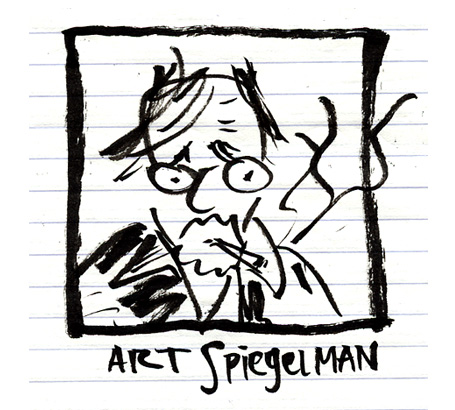
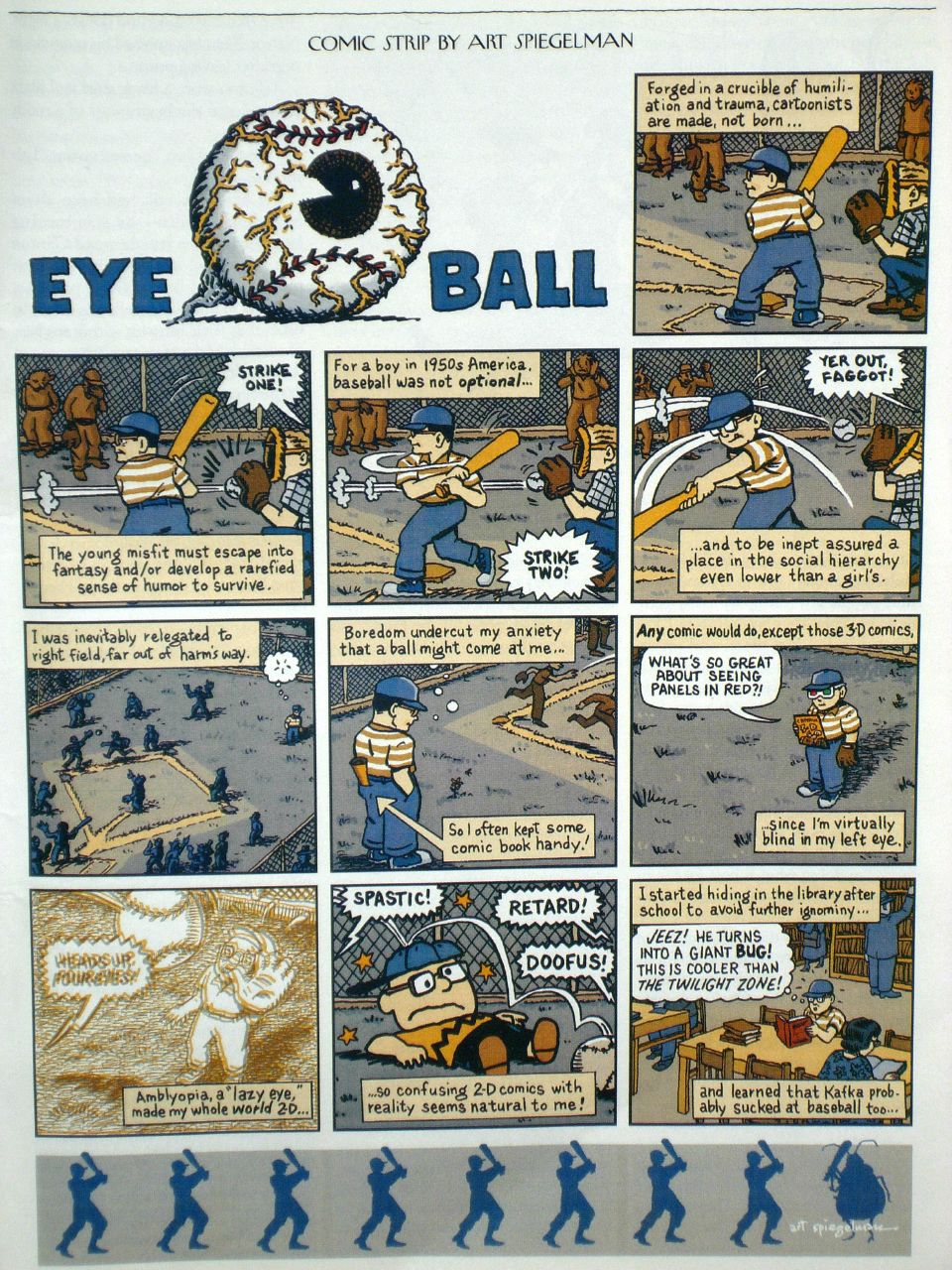
Art Spiegelman has amblyopia, or lazy eye — he’s virtually blind in his left eye. “[W]hich means that I don’t have binocular vision, and have difficulty seeing in three dimensions. This might have been part of what made me a cartoonist rather than a baseball player. I was rotten at sports, but I found that if I could draw good caricatures of the teachers I wouldn’t be doomed to be the butt of everybody’s scorn.”

Today I found a good scan of Spiegelman’s cartoon, “Eye Ball,” which originally ran in the New Yorker:

Art Spiegelman on his amblyopia: "Eye Ball" from THE NEW YORKER

(Why such an interest in vision? I should note that I have poor eyesight, mild red/green colorblindness, and a grandmother with cataracts and glaucoma. I’m terrified of going blind!)

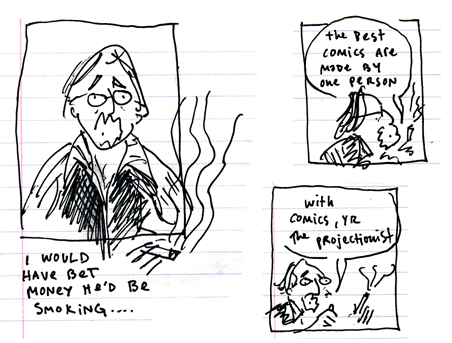
Ever since I read David Hockney’s Secret Knowledge, I’ve been very interested in binocular vision. Longtime readers might remember this sketchbook page from a post I did about the tyranny of linear perspective in comics:

Thinking about all this, I dug up an old New Yorker article by Oliver Sacks about stereoscopic vision (the article is called “Stereo Sue” — I’ll post the beginning in the comments below). Sacks talks about the discovery of stereoscopic vision, and then some alternatives for those who don’t have it:

There are, of course, many other ways of judging depth: occlusion of distant objects by closer objects, perspective (the fact that distant objects appear smaller), shading (which delineates the shape of objects), “aerial” perspective (the blurring and bluing of more distant objects by the intervening air), and, most important, motion parallax–the change of spatial relationships as we move our heads. All these cues, acting in tandem, can give a vivid sense of reality and space and depth. But the only way to actually perceive depth rather than judge it is with binocular stereoscopy.

And uh, well, I guess that’s all I’ve got on the subject at this point…

THE GATES OF PARADISE AS A COMIC

Wednesday, October 18th, 2006

paintingsaspanels.gif

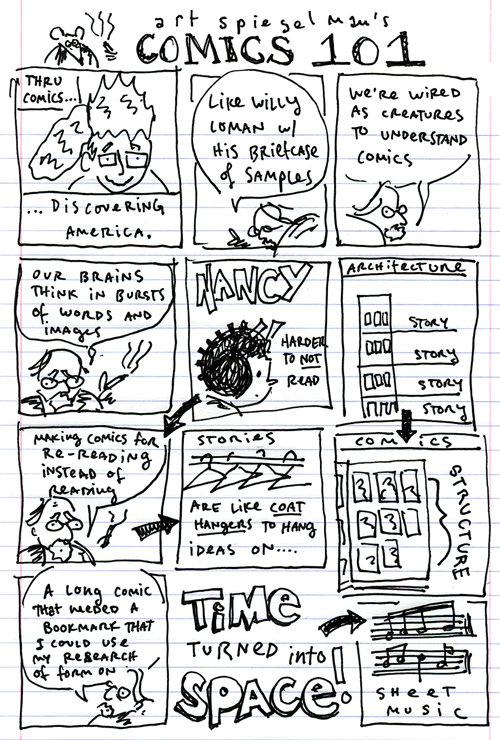
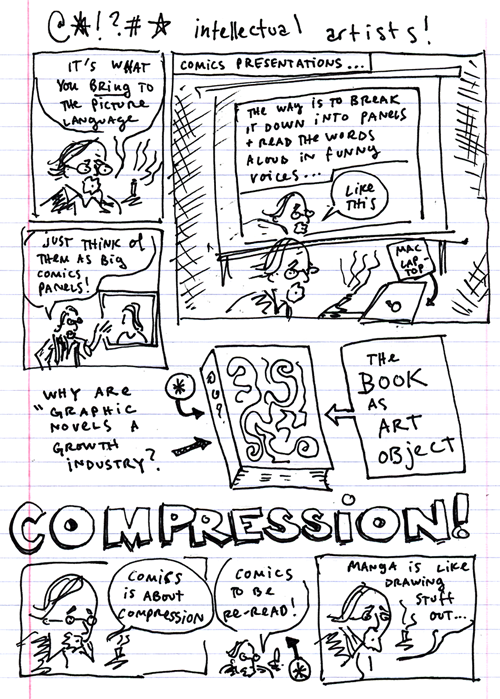
Ever since I saw this bit from Art Spiegelman’s PORTRAIT OF THE ARTIST AS A YOUNG %@?*! where his mentor Ken Jacobs tells a young Art to just think of paintings “as giant comic panels,” I’ve had a new eye towards paintings and all kinds of visual art. I spent a good part of our recent visit to the Art Institue of Chicago thinking, comic…comic…comics!

When I was 20, I had the good fortune to study renaissance art in Florence, Italy for a few summer months. My teacher was Kevin Murphy, an expert on Italian Renaissance Art who teaches at the British Institute of Florence. (His other claim to fame is giving art tours to Mel Gibson whenever Mel’s in town.)

Florence has been my favorite city in the world ever since. (And consequently, Meghan’s, too.)

So I was really excited to hear that three of the newly restored panels from Ghiberti’s “Gates of Paradise” are going to be at the Met while we’re on our honeymoon in New York.

The “Gates of Paradise,” are actually gilded bronze panels on the door to the Battistero di San Giovanni in the Piazza del Duomo:

gates.jpg

Their 10 panels depict scenes from the Old Testament, intricately illustrated in high and low relief. When the three-ton, 20-foot-tall doors were completed, in 1452, Michelangelo pronounced them grand enough to adorn the entrance to paradise, and so they became known as “The Gates of Paradise.” They have for centuries been considered one of the masterpieces of Western art.

Of course, it’s impossible for me to not look at those panels and think, “A huge comic!”

The individual panels themselves have a really interesting art history lesson to tell. See, in medieval times, before the invention of perspective, individual figures were compartmentalized into boxes, sized according to importance, and depth of field was weakly displayed by overlapping. With the adaptation of perspective technique, all of the sudden artists were able to fake the illusion of depth, and squeeze several different figures into the same scene.

Now here’s the bizarre part, courtesy of my old textbook, A. Richard Turner’s Renaissance Art:

We assume that a represented fictive space will contain narrative events understood to be happening simultaneously. For instance, a picture may show several events, say a friar preaching, a man leading a train of donkeys across a square, a fishmonger purveying his wares. We do not necessarily assume that these events have any narrative connection with one another, but because they occupy a common space, we assume they are happening at the same time.

Take a look at the “Isaac” panel from “The Gates”:

jacob.jpg

At first glance, it looks like a single moment frozen in time, right? Lots of people standing around.

But that’s not what the viewer of the fifteenth century saw, or what the artist intended! What you’re really looking at is the sequence of a story (Isaac’s unintentional blessing of Jacob) spread out across one compositional field, or panel. When you understand the story, the panel can be read sequentially:

blessingofjacob.gif

Perspective, in this case, isn’t just used to fake the illusion of depth and space: it’s actually used as a storytelling device. So if you look at The Gates as a comic, each panel doesn’t represent a moment of a story, it represents a complete story in itself, and the panels together tell a bigger story.

For some reason, this really blows my mind.

To see more really cool pictures of “The Gates,” check out this site.

THERE IS NO ONE THING, ONLY A DOZEN SURFACES

Wednesday, March 1st, 2006

workspace.jpg

Thinking lately about workspaces, about how working with the computer affords the sketchbook greater authority, because tiny scribbles can be scanned and blown up to gigantic proportions, mistakes can be erased, materials of all shapes and kinds and sizes can be formed into one thing–one computer file…and how, there is no original, only a digital collage.

Along the same lines, here’s Jonathan Safran Foer describing Art Spiegelman’s studio in his essay “Breakdownable,” from the great read, MASTERS OF AMERICAN COMICS:

“At the center of the office was an enviable Captain Kirk-like raised computer station: a pretty serious screen, two scanners, a pad on which to draw straight onto the computer, a side area for sketching, bottles of inks, a can of writing implements, shelves of cds, a stereo console, and various unidentifiable miscellany…

“Beside this setup was a very cool light table, on which rested a drawing-in-progress. Across from that, against the window, was an old-fashioned drafting table. If memory serves, there was a scratched-up desk across from that. There must have been half a dozen desks thoughout the office. How could one person, I wondered, need so many surfaces? Where is the army of Art Spiegelmans?

“We talked about the originals of his drawings. I wanted to use the excuse of this short essay to see them. Art explained that given the way he works, moving freely between paper and the computer, pen, pencil, and ink, no such things exist. There are sketches. And there are drawings done directly on the computer. And there are more fleshed-out drawings. And there are altered, cobbled-together images on the computer. But if one’s dream were to hang In the Shadow of No Towers, from beginning to end, one would be disappointed.”